奉城中学2026-2027高一英语期中试卷,你也喜欢边听音乐边写作业吗?
- 2026-11-21 12:12:12
奉城高中这篇完型填空期中考题整体定位在中等难度,接近市重点校内月考/期中完形水平,高于合格考难度,略低于春考、高考完形难度。词汇大部分是高一课标拓展词+高考核心词;题材是科普实验类,是上海英语完形很爱考的类型,但比记叙文枯燥,对逻辑阅读能力要求高于故事类完形。丢分可能集中在:短语辨析、熟词生义、抽象词义(push / engaged / make out)。

你可以拿到多少分呢?来试一试吧
Should you listen to music when you work?
Do you like to listen to music when you work?
Ask this question at a party, and you’ll probably get ___11___ responses. Some will say they love it, claiming that it improves their performance; others will say they find it distracting(分散注意力的) and cannot work ___12___ with music playing in the background.
Interestingly enough, our research has found that both of these viewpoints can be true. It just ___13___ on what sort of work you’re doing.
In a recent study, we brought participants into our lab to perform a variety of tasks. They included a(n) ___14___ task—searching through word lists and crossing out words containing the letter “a” and a more difficult task—memorizing word pairs and ___15___ each word to its partner. Some participants completed all of the tasks in silence, ___16___ others completed the tasks with instrumental music that was either loud or soft, and either simple or complex, the latter meaning music with more instruments being played. Several key findings ___17___ from our study.
We found that participants who listened to simple music or no music performed about the same on the easy task. However, participants who listened to ___18___ music performed best on the easy task.
On the contrary, participants performed worse on the more difficult task when they listened to any music, regardless of complexity or volume, compared to those who didn’t listen to any music.
How should we ___19___ these findings?
We suggest that people have limited mental resources from which both ___20___ and tasks can draw. We can become ___21___ and our minds may wander when these resources are not fully used. But we also can become over-excited and ___22___ when these resources are used up.
Not surprisingly, we typically need to use fewer of our mental resources when we perform easy tasks, whereas demanding tasks require more brainpower. However, because we might be less ___23___ during easier tasks, there’s a greater risk of drifting off. Music might give us the extra ___24___we need to overcome the monotony(单调). However, difficult tasks already demand a lot of our resources. Listening to music can become too much.
So best___25___should appear when we strike a “sweet spot,” which may depend on the type of music and the type of task.
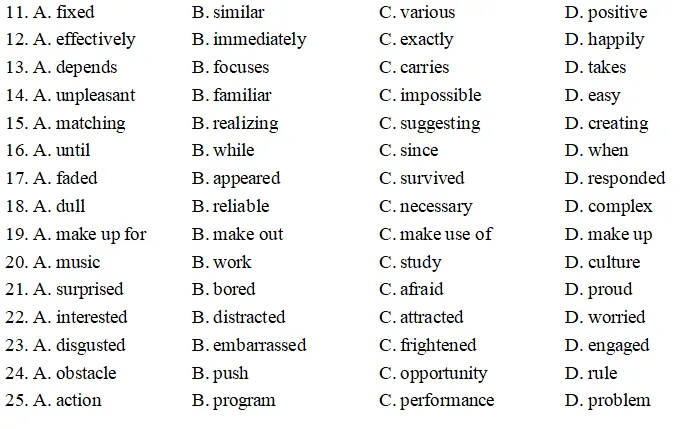
11.C 12.A 13.A 14.D 15.A 16.B 17.B 18.D 19.B 20.A 21.B 22.B 23.D 24.B 25.C
★文章主要内容:
主题:工作/学习的时候该不该听音乐?
文章先提出这个问题会得到不同看法:有人认为音乐提升效率,有人觉得会分心。然后介绍一项实验:设置简单任务、高难度任务两组受试者,一部分静音完成,一部分在不同音乐(简单/复杂、音量不同)下完成。
实验结论:
简单任务:听复杂音乐反而表现更好;
困难任务:无论什么音乐,都会降低表现。
原理解释:人的脑力资源有限,音乐和任务都要消耗脑力。简单任务用脑少,人容易无聊走神,音乐可以提神;难题本身已经占用大量脑力,再加音乐就过载。
最后总结:音乐能不能帮到你,取决于任务类型和音乐类型,找到平衡点,才有最好的表现。
★详解:
11.C. various
后文列举了两种截然不同的看法——有人喜欢音乐,有人觉得分心,说明这个问题会收获各种各样的回答。
12.A. effectively
本句说一部分人觉得音乐会分散注意力,所以没办法高效地开展工作。distracting(分心的)是核心提示词。
13.A. depends
固定短语depend on取决于。
这(听音乐是否有利)仅仅取决于你正在做的工作类型。
14.D. easy
后文出现信号词a more difficult task(难度更高的任务),形成对比,这里对应的是简单任务。
15.A. matching
固定搭配match sth. to sth.,把某物和某物配对。
任务是记忆单词对,把每个单词和它对应的搭档词匹配起来。
16.B. while
一部分参与者在安静环境完成任务,而另一部分伴着器乐完成任务。
17.B. appeared
几项关键的研究结果从我们的研究中显现、得出。
18.D. complex
上半句:听简单音乐或者不听音乐的人,在简单任务里表现差不多;但是听复杂音乐的人,在简单任务中表现最好。
19.B. make out
我们应当如何理解、解读这些研究发现?
20.A. music
人的脑力资源有限,音乐和手头任务都会消耗这份脑力资源。
21.B. bored
如果脑力资源没有被充分使用,我们容易感到无聊,思绪容易飘走、走神。对应后文简单任务用脑少的特点。
22.B. distracted
资源耗尽的时候,我们会过度兴奋并且分心。
23.D. engaged
be engaged (in sth.) 专注投入。
因为在简单任务中我们很难一直保持专注,更容易走神。
24.B. push
音乐可以给我们额外的动力,帮我们克服单调乏味。
25.C. performance
最好的表现会出现在这个平衡点上,这个平衡点取决于音乐类型和任务类型。
★积累:
make out(理解、弄懂)
make up for 弥补
make use of 利用
make up 编造
push:常见意思“推”,这里指“推动力、刺激感”
engaged:常见意思“订婚”,这里指“专注投入的”
performance:表演,表现、成绩

