高三英语朝阳区期中试卷D篇思维导图
- 2026-11-23 06:36:07
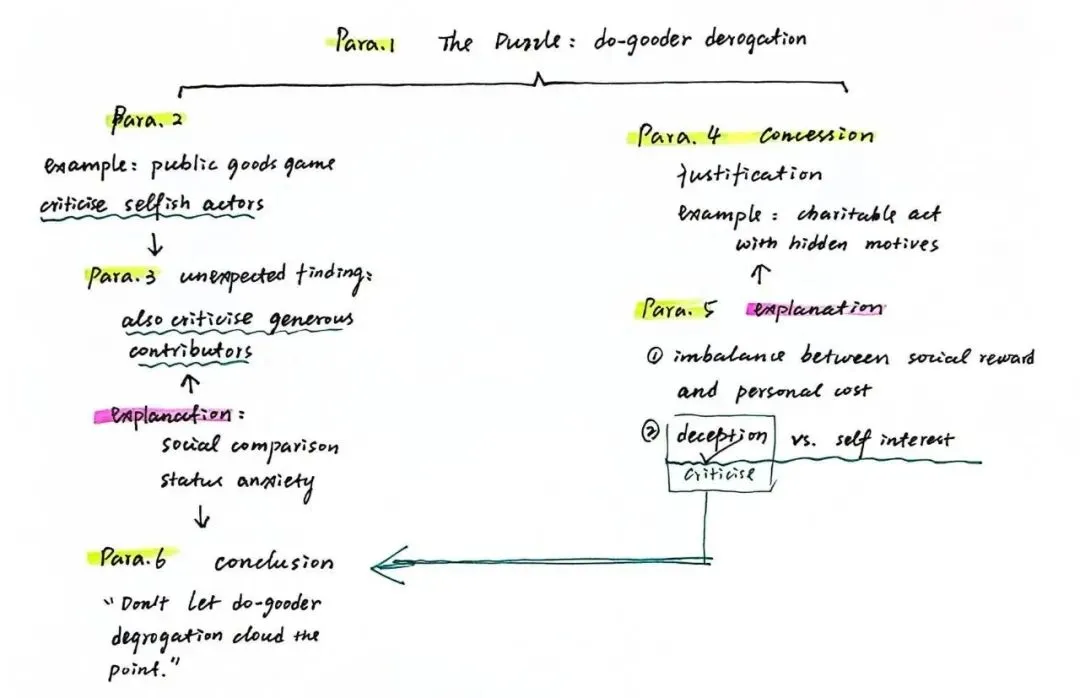
D篇最后一题通常都是送命题,本篇文章也不例外,为了让学生更加理解34题选C的理由,我会给学生画一下思维导图,让学生看清文章的“现象—原因—态度”结构,从而区分文章的核心问题与具体例子。
第1段提出“行善者为什么反而受到批评”这一反常现象;第2—5段通过实验、例子和心理机制解释其原因:人们可能出于社会比较、地位焦虑,以及对隐藏动机和回报是否相称的怀疑而贬低行善者;最后一段则提醒我们不要因此忽视助人的价值。
因此,思维导图揭示了:全文主要在回答的并不是“人们为什么行善”,而是“人们为什么怀疑行善者”。标题 Why Are Some People So Suspicious of Do-Gooders? 既抓住开头的核心疑问,又能统领中间各段的解释;结尾的劝告也正是对这一问题的回应。
34. Which would be the best title for the passage?
A. Why Do Do-Gooders Seek Social Rewards?
B. What Makes Good Deeds Seem Less Genuine?
C. Why Are Some People So Suspicious of Do-Gooders?
D. What Makes People Focus on Prosocial Actors’ Motives?
D
1. We admire people who help others, yet we are surrounded by people who often automatically seek a hidden motive behind selfless acts and may, once they discover such motives, treat the do-gooder worse than those acting openly in their own interest. This is known as do–gooder derogation.
2. Consider the public goods game. Each participant contributes money to a shared pool that accumulates interest like a bank account and is eventually divided equally, the best strategy being to contribute as much as possible. But this is risky: selfish actors can share little, keep their account full, and take a bite out of others’ contributions.
3. You might expect participants to look down on these free riders. In reality, generous contributors can be criticised just as strongly. “No one else does what he does; he makes us all look bad,” participants explain. Psychologist Nichola Raihani suggests these people are playing a “status game”: they may suspect that others are faking virtue to boost their social standing, which may reveal more about their own status anxiety.
4. Occasionally their suspicions are justified. Imagine that your friend Andy volunteers at a homeless shelter because he secretly hopes to bond with the manager, Daisy. If such behaviour puts you off, you are not alone. Studies suggest that people judge Andy more negatively than someone taking a coffee-shop shift for the same reason. This isn’t logical: true motives are hidden, and their “crime” is the same, yet people are more judgemental of the person benefiting the needy through a conventional charitable act, a phenomenon known as the tainted altruism effect.
5. Sebastian Hafenbrädl at the University of Navarra has explored this effect, assuming it arises from an unconscious calculation weighing the social rewards for an apparently good deed against its size and personal cost. “What taints prosocial actors is not self-interest itself, but the perception that they try to gain social rewards without paying the corresponding price, making them seem deceptive,” he proposed. What deserves criticism, then, is deception rather than self-interest itself.
6. Some people may do good simply to feel good, some people may do good to seek social rewards, and some people may act from genuine altruism with no hidden motives at all. But don’t let do-gooder derogation cloud the point. The warm glow from helping others is what we cannot ignore. Be a do-gooder whether there is a hidden motive or not.

