我相信这是全网最详细的主题教材语篇分类:(完整下载,全新V1.2版)附:一轮主题复习选必三Unit 3实战
- 2026-11-21 16:52:32
昨天的这篇文章:一轮复习-主题语境下四大版本教材单元课文分类(方便得不得了,直接下载)
必须说一下,属于比较简单分类,有不少教材单元没有录入,所以我今天来了一个全网最详细的分类:
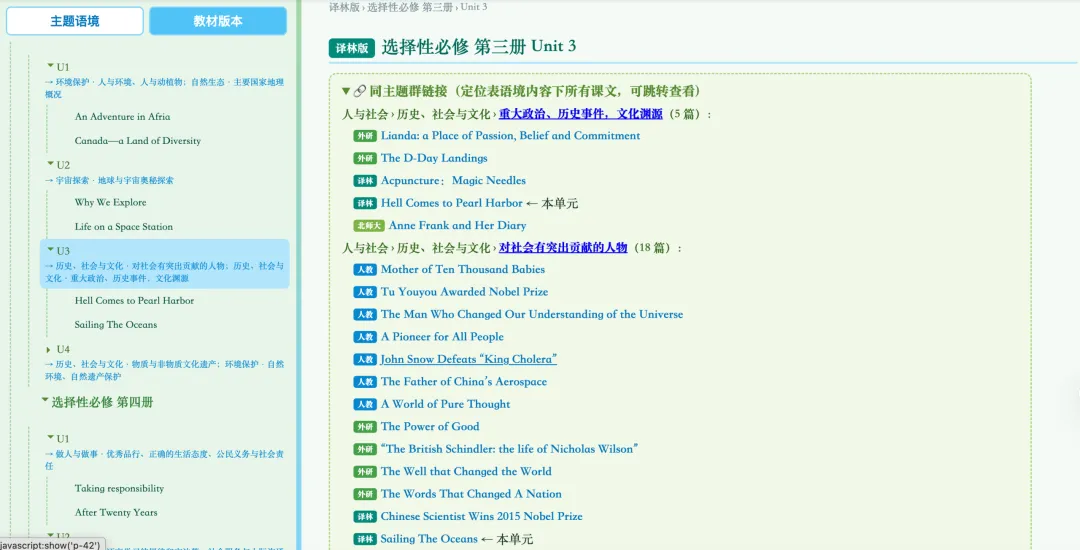
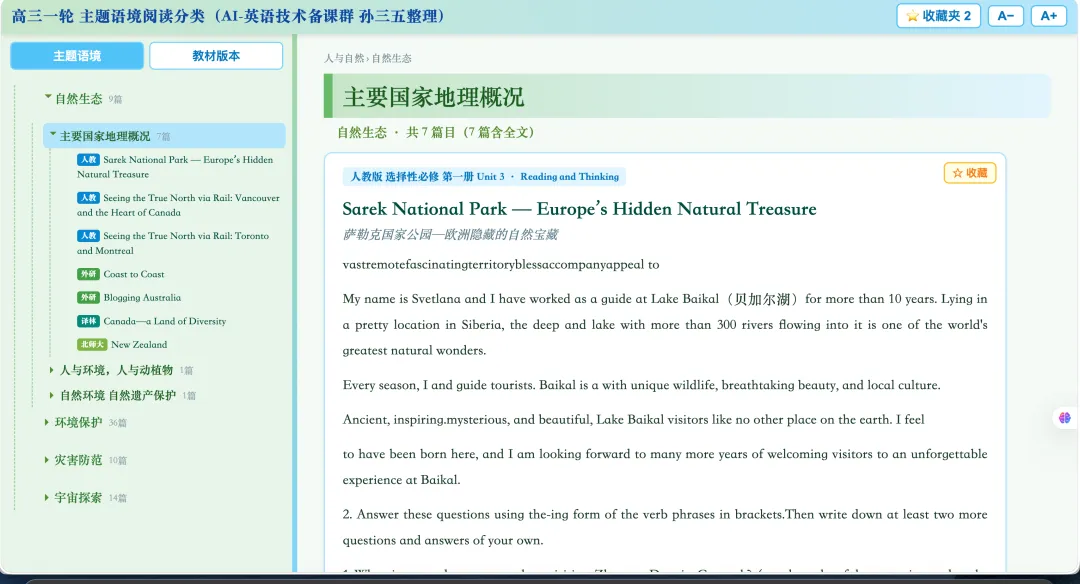
然后我上午做了一个学案,以下全部用时10分钟:
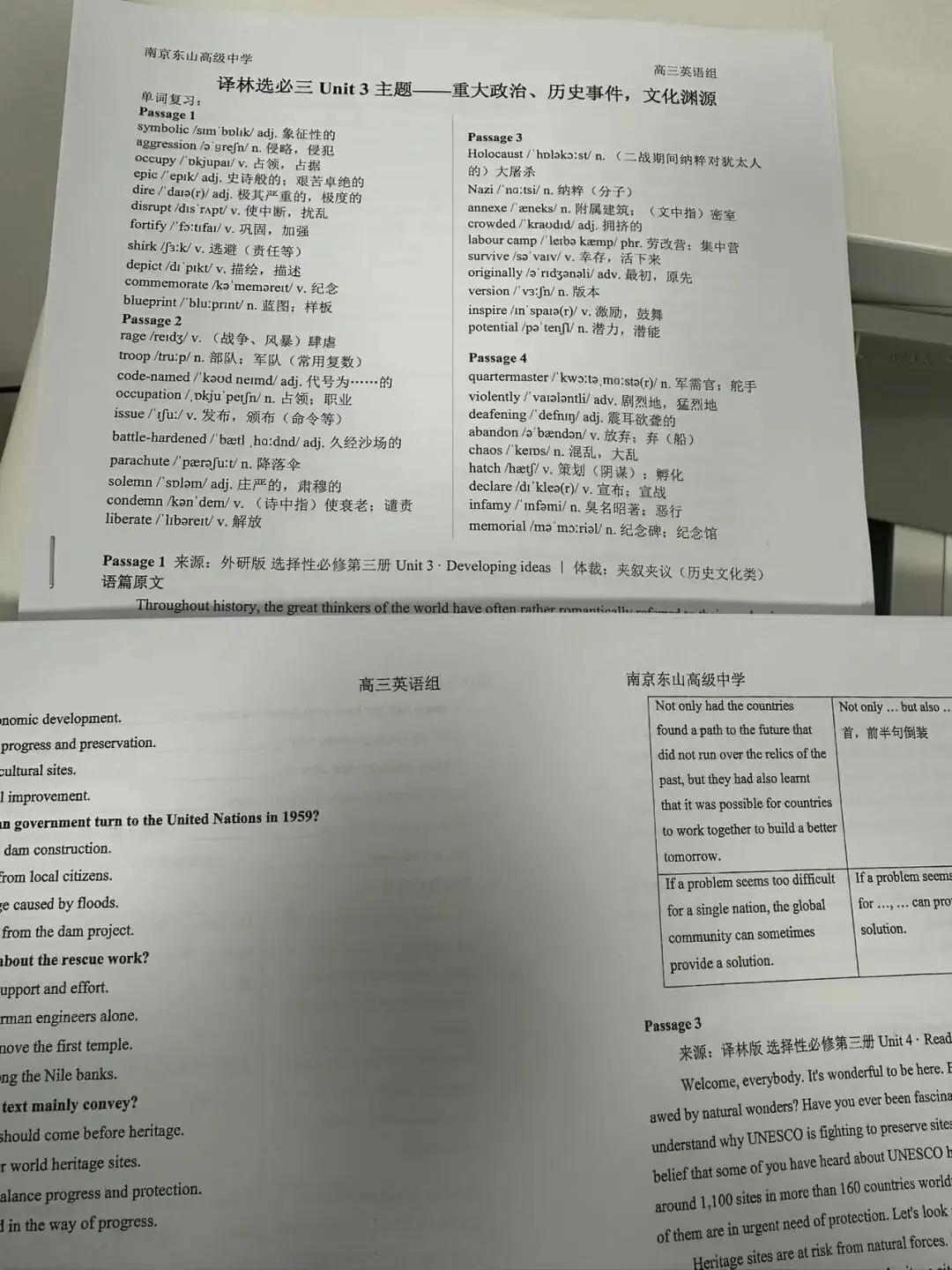
整个其实用到的skill就一个:高考命题设计,其它都是直接对话就可以了。
5群刚成立,五个群共享所有资料,包括其他群老师的好的作品和聊天干货。(进群唯一的要求:修改群名片,真诚交流探讨)
也就是,你和一万多个老师分享AI英语教学智慧。这是我非常乐意和感兴趣的事情。

译林选必三 Unit 3 主题——重大政治、历史事件,文化渊源
Passage 1
symbolic /sɪmˈbɒlɪk/ adj. 象征性的
aggression /əˈɡreʃn/ n. 侵略,侵犯
occupy /ˈɒkjupaɪ/ v. 占领,占据
epic /ˈepɪk/ adj. 史诗般的;艰苦卓绝的
dire /ˈdaɪə(r)/ adj. 极其严重的,极度的
disrupt /dɪsˈrʌpt/ v. 使中断,扰乱
fortify /ˈfɔːtɪfaɪ/ v. 巩固,加强
shirk /ʃɜːk/ v. 逃避(责任等)
depict /dɪˈpɪkt/ v. 描绘,描述
commemorate /kəˈmeməreɪt/ v. 纪念
blueprint /ˈbluːprɪnt/ n. 蓝图;样板
Passage 2
rage /reɪdʒ/ v. (战争、风暴)肆虐
troop /truːp/ n. 部队;军队(常用复数)
code-named /ˈkəʊd neɪmd/ adj. 代号为……的
occupation /ˌɒkjuˈpeɪʃn/ n. 占领;职业
issue /ˈɪʃuː/ v. 发布,颁布(命令等)
battle-hardened /ˈbætl ˌhɑːdnd/ adj. 久经沙场的
parachute /ˈpærəʃuːt/ n. 降落伞
solemn /ˈsɒləm/ adj. 庄严的,肃穆的
condemn /kənˈdem/ v. (诗中指)使衰老;谴责
liberate /ˈlɪbəreɪt/ v. 解放
Passage 3
Holocaust /ˈhɒləkɔːst/ n. (二战期间纳粹对犹太人的)大屠杀
Nazi /ˈnɑːtsi/ n. 纳粹(分子)
annexe /ˈæneks/ n. 附属建筑;(文中指)密室
crowded /ˈkraʊdɪd/ adj. 拥挤的
labour camp /ˈleɪbə kæmp/ phr. 劳改营;集中营
survive /səˈvaɪv/ v. 幸存,活下来
originally /əˈrɪdʒənəli/ adv. 最初,原先
version /ˈvɜːʃn/ n. 版本
inspire /ɪnˈspaɪə(r)/ v. 激励,鼓舞
potential /pəˈtenʃl/ n. 潜力,潜能
Passage 4
quartermaster /ˈkwɔːtəˌmɑːstə(r)/ n. 军需官;舵手
violently /ˈvaɪələntli/ adv. 剧烈地,猛烈地
deafening /ˈdefnɪŋ/ adj. 震耳欲聋的
abandon /əˈbændən/ v. 放弃;弃(船)
chaos /ˈkeɪɒs/ n. 混乱,大乱
hatch /hætʃ/ v. 策划(阴谋);孵化
declare /dɪˈkleə(r)/ v. 宣布;宣战
infamy /ˈɪnfəmi/ n. 臭名昭著;恶行
memorial /məˈmɔːriəl/ n. 纪念碑;纪念馆
Passage 1 来源:外研版 选择性必修第三册 Unit 3 · Developing ideas | 体裁:夹叙夹议(历史文化类)
语篇原文
Throughout history, the great thinkers of the world have often rather romantically referred to their academic struggles as being like "war". However, for most of them, the "war" has been purely symbolic. Real war is never romantic as it brings suffering and immense challenges.
In 1937, the aggression of the Japanese army brought disaster to China's three great universities: Peking University and Tsinghua University were occupied by Japanese troops, while Nankai University was completely destroyed by bombing. To save their educational and intellectual heritage, the three universities joined together in Kunming as National Southwest Associated University, otherwise known as Lianda.
Professors and students alike in the three universities made an epic journey over a distance of more than 2,000 kilometres, most of them on foot. Their bed was the dusty road and their roof was the open sky, often lit up by exploding Japanese bombs. Conditions were little better once they reached the remote and mountainous south-west part of China. They had to live in rough buildings, packed 40 to a room, like sardines. There were dire shortages of food, books, and equipment. Furthermore, classes were frequently disrupted due to fierce air attacks and often had to be held before 10 am and after 4 pm.
However, despite the immense hardships and the daunting challenges, it was right in this place, over a period of eight long years, that the nation's intellectual heritage was not only guarded but fortified by the passion and belief of the worthy academics of Lianda. It is no wonder that many, if not most, of China's leading scholars and scientists emerged at Lianda, including the two Nobel Prize-winning physicists, Yang Zhenning and Li Zhengdao. "Lianda laid the foundation for every achievement I have made," Yang recalled. He still remembers learning in a temporary classroom that had no glass in the windows. "On windy days, we had to hold down the paper on the desk, which would otherwise be blown away," he said.
With the country at war, students at Lianda were not going to shirk their duty. Driven by a sense of commitment, a great many joined the army to resist the Japanese invaders and defend the honour of the nation. In fact, Lianda provided the largest number of student-soldiers from any campus in China. Of the thousands of college students from all over China who served as interpreters, one tenth were from Lianda, including the well-known translators Zha Liangzheng and Xu Yuanchong. Zha later depicted the contributions of his peers in a poem:
Softly, on the hillside forgotten by all, / misty rain falls in a gentle breeze; / There is no trace of the footprints of history; / Where brave souls once stood, breathing new life into the trees.
A product of the war, Lianda is now physically gone. But it has become the crowning glory of China's modern universities, not only because of its prominent professors and talented students, but also because of the school's strong spirit of perseverance and dedication. In 2017, representatives from Peking University, Tsinghua University, Nankai University and Yunnan Normal University gathered to commemorate the 80th anniversary of its founding.
More than eighty years on, the priceless contribution of Lianda still needs to be reaffirmed. It has become part of the collective memory of the Chinese nation, with its spirit as the blueprint for all universities in China in the modern era.
选择题
1. Why does the author mention great thinkers' "war" in paragraph 1?
A. To praise their academic devotion.
B. To introduce Lianda's real hardships.
C. To compare two kinds of war.
D. To question their romantic view.
2. What did Yang Zhenning recall about Lianda?
A. It trained him to win the Nobel Prize.
B. It provided the best learning facilities.
C. It shaped the basis of his achievements.
D. It taught him to work against the wind.
3. What do the statistics in paragraph 5 indicate?
A. One tenth of Lianda students became translators.
B. Most Chinese student-soldiers came from Lianda.
C. Interpreters played a key role in battles.
D. Lianda students' strong sense of duty.
4. What does the text mainly tell us about Lianda?
A. It lives on through its spirit and legacy.
B. It succeeded thanks to its modern facilities.
C. It was forced to move three times in the war.
D. Its glory faded soon after the war ended.
短语翻译填空
根据括号内的汉语提示,用原文中的短语补全句子(注意时态与词形变化)。
1. Great thinkers often __________________ their academic struggles __________________(把……称作/比作……)"war".
2. In 1937, the aggression of the Japanese army __________________(给中国三所名校带来了灾难).
3. The three universities joined together in Kunming to __________________(挽救他们的教育与学术遗产).
4. Professors and students made __________________(一段史诗般的旅程)of more than 2,000 kilometres, most of them on foot.
5. They had to live in rough buildings, __________________(四十人挤一间屋), like sardines.
6. There were __________________(极度匮乏)food, books and equipment.
7. Classes were frequently __________________(因猛烈空袭而中断).
8. With the country at war, students at Lianda __________________(不肯逃避自己的责任).
9. A great many joined the army to resist the invaders and __________________(捍卫民族尊严).
10. "Lianda __________________(为……奠定基础)every achievement I have made," Yang recalled.
写作句式仿写
Their bed was the dusty road and their roof was the open sky, often lit up by exploding Japanese bombs. | 暗喻+排比,写尽旅途艰苦 | Their desk was __________________(冰冷的石板)and their lamp was __________________(天上的月亮), often covered by passing clouds. |
It is no wonder that many, if not most, of China's leading scholars and scientists emerged at Lianda. | It is no wonder that … 难怪…… | __________________(难怪)he won first prize, for he practised every single day. |
Driven by a sense of commitment, a great many joined the army to resist the Japanese invaders. | Driven by …, … 过去分词短语作原因状语 | __________________(怀着对家乡的热爱), the young man returned to teach in the village school. |
Passage 2 来源:外研版 选择性必修第三册 Unit 3 | 体裁:记叙+说明混合(历史事件)
语篇原文
By spring 1944, the Second World War had been raging across the globe for about five years. But along the south coast of England, something unusual was happening: Allied troops made up mainly of British, Canadian and American soldiers were gathering in large numbers. This marked one of the final stages of a top-secret operation that had been months, perhaps years, in the planning. Code-named "Operation Overlord", it was the largest combined sea, air and land operation in history, the aim being to free north-west Europe from German occupation. After waiting for the perfect combination of weather, moon and tides, the date for the start of Operation Overlord was set for 6 June.
An order issued by Supreme Allied Commander General Eisenhower to the troops read: "Your task will not be an easy one. Your enemy is well trained, well equipped and battle-hardened ... But this is the year 1944 ... The tide has turned! The free men of the world are marching together to Victory! I have full confidence in your courage, devotion to duty and skill in battle. We will accept nothing less than full Victory!"
With these words ringing in their ears, Allied soldiers prepared for what would become known as D-Day. At dawn on 6 June, thousands landed by parachute behind enemy lines in northern France. Meanwhile, thousands more were journeying across the English Channel to Normandy, protected by fighter planes in the skies above them. Their objective was clear: to reach the Normandy beaches along about 80 kilometres of French coastline. But even in the depths of war, few could have been prepared for the violence and horror they would experience there.
Seventy years later, men who had fought on D-Day gathered on both sides of the English Channel, where people were coming together for memorial ceremonies. As part of this solemn and moving occasion, a former soldier read out to the crowd these lines from the poem For the Fallen, by Laurence Binyon: They shall grow not old, as we that are left grow old: / Age shall not weary them, nor the years condemn. / At the going down of the sun and in the morning / We will remember them.
Survivors of the D-Day landings continue to meet to remember the fellow soldiers and friends they lost that day. Although each year they are fewer in number, their outstanding acts of courage mean that we will always remember them — as well as those who lost their lives on the beaches of northern France.
The fiercest fighting was at Omaha Beach. The enemy were hiding, ready to attack the Allied soldiers even before they reached land. Boats were hit and men drowned, while those who did make it to the beach faced heavy machine gunfire. By mid-morning, hundreds lay dead in the water and amongst the tanks on the beach. One soldier recalled how he barely made it with bombs falling all around him: "I was the first one out. The seventh man was the next one to get across the beach without being hit. All the ones in between were hit. Two were killed; three were injured. That's how lucky you had to be."
But, despite the high cost in human life, the D-Day landings were a success and were seen widely as the beginning of the end of the Second World War. By the end of August 1944, the Allies had reached the River Seine, Paris was liberated, and the Germans had been removed from north-west France. The Allied forces then prepared to enter Germany, where they would meet up with the Soviet military moving in from the east.
选择题
1. What do we know about Operation Overlord?
A. It was planned within a few weeks.
B. It involved only the naval forces.
C. It was meant to drive Germans from north-west Europe.
D. It started in the spring of 1944.
2. What did Eisenhower's order convey to the troops?
A. It warned them to retreat if necessary.
B. It listed the weaknesses of the enemy.
C. It promised them newer equipment.
D. It voiced firm belief in their victory.
3. What does the soldier's account show about Omaha Beach?
A. The extreme danger of the landing there.
B. The soldiers' lack of training.
C. The success of a surprise attack.
D. The bravery of the German defenders.
4. What is the main purpose of the text?
A. To praise Eisenhower's leadership.
B. To honour the courage and sacrifice on D-Day.
C. To describe the largest operation at sea.
D. To explain how the Allies won WWII.
短语翻译填空
根据括号内的汉语提示,用原文中的短语补全句子(注意时态与词形变化)。
1. By spring 1944, the Second World War had been __________________(在全球肆虐)for about five years.
2. Allied troops were __________________(大量集结)along the south coast of England.
3. "Operation Overlord" was __________________(一项绝密行动)that had been years in the planning.
4. The aim of the operation was to __________________(把西北欧从德国占领下解放出来).
5. General Eisenhower __________________(向部队发布了一道命令)before the landing.
6. "__________________(形势已经逆转)!" Eisenhower declared in his order.
7. At dawn on 6 June, thousands of soldiers __________________(在敌后伞降着陆)in northern France.
8. Seventy years later, people came together on both sides of the Channel for __________________(纪念仪式).
9. Survivors continue to meet to __________________(缅怀他们失去的战友).
10. The Allied forces prepared to enter Germany, where they would __________________(与苏军会师).
写作句式仿写
We will accept nothing less than full Victory! | nothing less than 完全是/务必是(表决心) | For our final exam, we will accept __________________(非全力以赴不可). |
With these words ringing in their ears, Allied soldiers prepared for what would become known as D-Day. | with +宾语+现在分词,画面感强 | With __________________(老师的鼓励回响在耳边), she stepped onto the stage. |
But even in the depths of war, few could have been prepared for the violence and horror they would experience there. | few could have been prepared for … 几乎无人能对……有心理准备 | Few could __________________(对黑夜登山的艰难有心理准备). |
Passage 3 来源:北师大版 必修第二册 Unit 6 · Reading Club 2 | 体裁:记叙文(人物与作品)
语篇原文
Since 1947, The Diary of Anne Frank has been one of the most powerful accounts of the experience of the Holocaust and has helped to give a human face to the suffering it involved. Although it was written by a young girl in a terrible situation, it conveys a message of courage and hope.
Throughout history, we can find examples of inspiring young people who showed courage and hope in times of extreme hardship. Anne Frank is one of them. Her diary is one of the most important diaries ever written.
Anne was born on 12 June, 1929, in Frankfurt, Germany. Her family was Jewish. During World War II, they had to live in a secret hiding place to escape the Nazi Holocaust. This was a time when the German Nazis were killing Jews. Around six million Jews died in the Holocaust.
Anne's father was a successful businessman in Germany. When the Nazis took control of the country in 1933, the Frank family moved to Amsterdam in the Netherlands. Later, this city became unsafe, so Anne's father prepared some secret rooms above his offices. On 6 July, 1942, Anne moved into this "secret annexe", with her parents, her older sister Margot, and four other Jewish people.
The annexe was small and crowded. Everyone had to be very quiet. They were often hungry and always afraid of being caught. To keep busy, Anne wrote in her diary. She described her daily life and her struggles, but also wrote about her hopes and dreams. "I don't think of all the misery," she wrote, "but of the beauty that still remains."
The family was in hiding for two years. During that time, Anne kept a diary and wrote in it almost every day. On 4 August, 1944, the annexe was discovered and everyone hiding there were sent to labour camps. Anne and her sister Margot died in a German camp in March 1945. Of all the people who had hidden in the annexe, only Otto Frank, Anne's father, survived.
Anne's diary was discovered by friends and returned to Otto Frank after the war. The diary was originally written in Dutch. Since then, it has been published in at least 67 languages and 31 million copies have been sold. The English version is called The Diary of a Young Girl. Today, the annexe building in Amsterdam where Anne and her family hid is a museum called Anne Frank House.
Although Anne's life in hiding was extremely difficult, her diary reveals her positive attitude. For example, in 1944, she wrote, "In spite of everything I still believe that people are really good at heart."
Anne Frank's diary has inspired teenagers everywhere. "The good news", she wrote, "is that you don't know how great you can be, how much you can love, what you can accomplish, and what your potential is!"
选择题
1. Why did the Frank family move to Amsterdam in 1933?
A. To start a new business in the city.
B. To hide in the rooms above the offices.
C. To seek protection from the Dutch government.
D. To get away from Nazi rule in Germany.
2. What does the underlined word "misery" in paragraph 5 probably mean?
A. Great suffering. B. Daily routine. C. Secret hiding. D. Quiet beauty.
3. What happened to Anne's family in August 1944?
A. They fled to another hiding place.
B. They were found and sent to camps.
C. They were rescued by their friends.
D. They managed to survive the war.
4. What is the main idea of the text?
A. Anne's diary records her family's tragic death.
B. The Holocaust caused great suffering to Jews.
C. Anne's diary spreads courage and hope beyond her time.
D. Anne's positive attitude saved her from the war.
短语翻译填空
根据括号内的汉语提示,用原文中的短语补全句子(注意时态与词形变化)。
1. The Diary of Anne Frank is __________________(最有力量的记述之一)of the experience of the Holocaust.
2. Many inspiring young people showed courage and hope __________________(在极端困苦的时期).
3. During the war, Anne's family had to live in __________________(一个秘密的藏身之处).
4. The Nazis __________________(控制了整个国家)in 1933.
5. __________________(为了让自己忙起来), Anne wrote in her diary.
6. During the two years in hiding, Anne __________________(坚持记日记)and wrote almost every day.
7. In August 1944, everyone hiding in the annexe __________________(被送往集中营).
8. Since then, the diary has __________________(以至少 67 种语言出版).
9. Although her life in hiding was difficult, her diary reveals __________________(积极的人生态度).
10. Anne Frank's diary has __________________(激励着各地的青少年).
写作句式仿写
"I don't think of all the misery, but of the beauty that still remains." | not … but … 取舍结构,表达乐观 | I don't think of __________________(眼前的困难), but of __________________(我取得的进步). |
"In spite of everything I still believe that people are really good at heart." | in spite of everything 尽管发生了这一切 | __________________(尽管发生了这一切), I still believe that hard work pays off in the end. |
"The good news is that you don't know how great you can be, how much you can love, what you can accomplish, and what your potential is!" | The good news is that … + 并列宾语从句 | The good news is that you don't know __________________(你能走多远), __________________(你能有多强大), and what you can achieve! |
Passage 4 来源:译林版 选择性必修第三册 Unit 3 · Extended reading | 体裁:记叙文(幸存者叙事)
语篇原文
It was Sunday, December 7, 1941. As usual, the wake-up call came at 5:45 a.m. The men aboard the warship USS Arizona stretched and rubbed their eyes. Seaman Russell Warriner was awakened by Quartermaster Louis Conter. Russell made his bed and helped clean the huge, shared room. The men went to the washroom, dressed in their uniforms and sat down to breakfast. It looked like it would be a normal day on board the ship.
But nobody ate their breakfast: at that moment, there was a huge crashing sound from above. The ship shook violently and the men looked at each other in horror. Above their heads, hundreds of Japanese planes circled like eagles. They were diving down to drop bombs on Pearl Harbor. The scream of their engines was deafening. As bombs thundered all around, clouds of black smoke rose into the sky and hung over the sea. Russell felt his blood freeze, but he quickly came to himself and rushed up to the deck. Moments later, a bomb hit the USS Arizona and Russell was thrown more than 100 meters across the ship. He suffered serious burns on his hands, arms and legs, and watched many of his friends die.
Louis, meanwhile, also standing on the deck, was lucky not to be thrown into the sea. With only minor injuries, he was able to help others who were severely burnt and in terrible pain. After receiving the order to abandon ship, Louis saved more men from the water, dragging them into the lifeboat. In the chaos and confusion after the attack, the US Navy sent a message to his family that Louis had been killed in the attack. Luckily, he was able to get in touch with them before the message arrived. Despite his remarkable actions, Louis did not think that he was a hero. "The heroes are the ones that gave their lives that day," he said.
Russell was saved from the water, but he was badly burnt, bleeding heavily. Fortunately, he was taken to hospital and survived. For many years, Russell refused to talk about what happened that morning, describing it simply as "hell". His wife Elsa said, "When he opened up later on, he always mentioned the horror of it."
Louis and Russell would never forget the terrible scene of the attack, but they were fortunate enough to be among the few survivors from the Arizona. Nobody had expected the bombing. Japan had hatched a plot to launch a surprise attack on Pearl Harbor, so the attack began without warning and without declaring war on the United States. The attack destroyed nearly 20 American ships and over 180 airplanes. In total, more than 2,000 American people were killed and over 1,000 others were wounded that day. More than 1,000 people aboard the Arizona lost their lives. Out of 37 sets of brothers, Russell and his brother were the only full pair to survive the attack.
The surprise attack came as a great shock to the whole nation. The next day, President Roosevelt delivered his famous Pearl Harbor Speech, in which he described December 7 as "a date which will live in infamy" and asked that the US Congress declare war on Japan. In response to the attack and the president's address, the United States joined the Second World War.
Today, the USS Arizona lies where it sank: in the middle of the Pacific Ocean. Its location is marked with a memorial shaped like a bridge, which crosses the ship's sunken remains. Each year, more than two million people visit the memorial. They come to see the shadow of the ship at the bottom of Pearl Harbor, to learn about the attack, to show respect for those who had lost their lives in the attack and to pray for world peace. Although about eight decades has passed, the attack on Pearl Harbor, one of the darkest episodes in American history, will never be forgotten.
选择题
1. Why does the author describe the normal morning in paragraph 1?
A. To highlight the suddenness of the attack.
B. To show the sailors' daily routine.
C. To praise the crew's good discipline.
D. To explain the warship's inner structure.
2. What did Louis mean by "The heroes are the ones that gave their lives"?
A. He regretted surviving the attack.
B. He denied having saved anyone.
C. He saw the fallen as the real heroes.
D. He wished to become a hero himself.
3. What do the numbers in paragraph 5 show?
A. The efficiency of the Japanese navy.
B. The heavy cost of the surprise attack.
C. The strength of the US Pacific Fleet.
D. The quick response of the US Navy.
4. What is the author's purpose in writing the text?
A. To describe the design of the memorial.
B. To explain why the US joined WWII.
C. To criticize Japan's surprise attack.
D. To keep alive the memory of the attack.
短语翻译填空
根据括号内的汉语提示,用原文中的短语补全句子(注意时态与词形变化)。
1. As usual, __________________(起床号)came at 5:45 a.m.
2. Hundreds of Japanese planes __________________(俯冲下来投弹)on Pearl Harbor.
3. Russell felt his blood freeze, but he quickly __________________(回过神来)and rushed up to the deck.
4. Russell __________________(手和手臂严重烧伤)and watched many of his friends die.
5. After receiving the order to __________________(弃船), Louis saved more men from the water.
6. Luckily, Louis was able to __________________(与家人取得联系)before the message arrived.
7. Japan had __________________(策划了偷袭的阴谋)on Pearl Harbor.
8. The attack began without warning and __________________(不宣而战).
9. President Roosevelt asked the US Congress to __________________(对日宣战).
10. Visitors come to show respect for the dead and to __________________(祈求世界和平).
写作句式仿写
It looked like it would be a normal day on board the ship. | It looked like … 以平静反衬突变 | It looked like __________________(这会是一个平静的夜晚), but then the phone rang. |
Russell felt his blood freeze, but he quickly came to himself and rushed up to the deck. | 情绪描写+动作链(felt …, came to …, rushed …) | She felt __________________(心跳骤停), but she quickly came to herself and ran towards the exit. |
Despite his remarkable actions, Louis did not think that he was a hero. | Despite …, … did not think … 低调谦逊的表达 | Despite __________________(她出色的表现), the young nurse did not think that she was special. |
本主题写作题(议论文)
题目:西南联大在战火中坚持办学,培养出大批杰出人才。请你以 Hardships Make Us Stronger 为题写一篇英语短文,谈谈你对"苦难使人强大"的看法,可结合联大事例,100 词左右,至少使用本单元 3 个短语或句型。
写作支架:lay the foundation for / be driven by a sense of commitment / dire shortages of / It is no wonder that … / not going to shirk one's duty / in times of extreme hardship
参考范文:
History shows that hardships make us stronger, and Lianda is the best proof. Despite dire shortages of food, books and equipment, its professors and students never stopped learning. Driven by a sense of commitment, many students even joined the army to defend the honour of the nation. The hard years laid the foundation for their later achievements. It is no wonder that so many leading scholars emerged at Lianda. Difficulties are not walls in our way; they are steps that lift us higher.(88 词)
Passage 1 Lianda: a Place of Passion, Belief and Commitment 联大:一个充满热情、信念和奉献的地方
来源:外研版 选择性必修第三册 Unit 3 · Developing ideas | 体裁:夹叙夹议(历史文化类)
一、语篇原文
Throughout history, the great thinkers of the world have often rather romantically referred to their academic struggles as being like "war". However, for most of them, the "war" has been purely symbolic. Real war is never romantic as it brings suffering and immense challenges.
In 1937, the aggression of the Japanese army brought disaster to China's three great universities: Peking University and Tsinghua University were occupied by Japanese troops, while Nankai University was completely destroyed by bombing. To save their educational and intellectual heritage, the three universities joined together in Kunming as National Southwest Associated University, otherwise known as Lianda.
Professors and students alike in the three universities made an epic journey over a distance of more than 2,000 kilometres, most of them on foot. Their bed was the dusty road and their roof was the open sky, often lit up by exploding Japanese bombs. Conditions were little better once they reached the remote and mountainous south-west part of China. They had to live in rough buildings, packed 40 to a room, like sardines. There were dire shortages of food, books, and equipment. Furthermore, classes were frequently disrupted due to fierce air attacks and often had to be held before 10 am and after 4 pm.
However, despite the immense hardships and the daunting challenges, it was right in this place, over a period of eight long years, that the nation's intellectual heritage was not only guarded but fortified by the passion and belief of the worthy academics of Lianda. It is no wonder that many, if not most, of China's leading scholars and scientists emerged at Lianda, including the two Nobel Prize-winning physicists, Yang Zhenning and Li Zhengdao. "Lianda laid the foundation for every achievement I have made," Yang recalled. He still remembers learning in a temporary classroom that had no glass in the windows. "On windy days, we had to hold down the paper on the desk, which would otherwise be blown away," he said.
With the country at war, students at Lianda were not going to shirk their duty. Driven by a sense of commitment, a great many joined the army to resist the Japanese invaders and defend the honour of the nation. In fact, Lianda provided the largest number of student-soldiers from any campus in China. Of the thousands of college students from all over China who served as interpreters, one tenth were from Lianda, including the well-known translators Zha Liangzheng and Xu Yuanchong. Zha later depicted the contributions of his peers in a poem:
Softly, on the hillside forgotten by all, / misty rain falls in a gentle breeze; / There is no trace of the footprints of history; / Where brave souls once stood, breathing new life into the trees.
A product of the war, Lianda is now physically gone. But it has become the crowning glory of China's modern universities, not only because of its prominent professors and talented students, but also because of the school's strong spirit of perseverance and dedication. In 2017, representatives from Peking University, Tsinghua University, Nankai University and Yunnan Normal University gathered to commemorate the 80th anniversary of its founding.
More than eighty years on, the priceless contribution of Lianda still needs to be reaffirmed. It has become part of the collective memory of the Chinese nation, with its spirit as the blueprint for all universities in China in the modern era.
二、难词解释
三、高考命题选择题(仿高考四选一)
1. Why does the author mention great thinkers' "war" in paragraph 1?
A. To praise their academic devotion.
B. To introduce Lianda's real hardships.
C. To compare two kinds of war.
D. To question their romantic view.
2. What did Yang Zhenning recall about Lianda?
A. It trained him to win the Nobel Prize.
B. It provided the best learning facilities.
C. It shaped the basis of his achievements.
D. It taught him to work against the wind.
3. What do the statistics in paragraph 5 indicate?
A. One tenth of Lianda students became translators.
B. Most Chinese student-soldiers came from Lianda.
C. Interpreters played a key role in battles.
D. Lianda students' strong sense of duty.
4. What does the text mainly tell us about Lianda?
A. It lives on through its spirit and legacy.
B. It succeeded thanks to its modern facilities.
C. It was forced to move three times in the war.
D. Its glory faded soon after the war ended.
四、答案与逐题解析
答案速查:1—4 B C D A
第1题 B 【思维层级:阐释(段落功能)| 推理距离:二级】
定位句:However, for most of them, the "war" has been purely symbolic. Real war is never romantic as it brings suffering and immense challenges.(然而对大多数学者来说,"战争"纯属比喻;真正的战争从不浪漫,它带来苦难与巨大挑战。)
正答:B. To introduce Lianda's real hardships.——首段转折句"Real war is never romantic"是铺垫,引出下文联大在真实战争中的苦难;考"首段功能"而非首段内容。
第2题 C 【思维层级:阐释(引语理解)| 推理距离:一级】
定位句:"Lianda laid the foundation for every achievement I have made," Yang recalled.("联大为我取得的每一项成就奠定了基础,"杨振宁回忆道。)
正答:C. It shaped the basis of his achievements.——laid the foundation → shaped the basis;every achievement → his achievements;动词换写,最长连续重合 1 词。
第3题 D 【思维层级:推断(数据背后)| 推理距离:二级】
定位句:Driven by a sense of commitment, a great many joined the army … Lianda provided the largest number of student-soldiers from any campus … one tenth were from Lianda.(在责任感的驱使下,大批学生参军……联大提供了全国高校中最多的学生兵;全国大学生翻译官中十分之一来自联大。)
正答:D. Lianda students' strong sense of duty.——抽象承载词 sense of duty 回指段首"not going to shirk their duty / a sense of commitment"两处;数字只是证据。
第4题 A 【思维层级:宏观(主旨)| 推理距离:二级】
定位句:Lianda is now physically gone. But it has become the crowning glory of China's modern universities … with its spirit as the blueprint for all universities in China.(联大在物质上已不复存在,但它已成为中国现代大学无上的荣耀……其精神是当今中国所有大学的蓝图。)
正答:A. It lives on through its spirit and legacy.——归纳 P7—P8:physically gone ↔ lives on,spirit/blueprint → legacy;两处以上可回指。
五、短语翻译填空(挖空)
根据括号内的汉语提示,用原文中的短语补全句子(注意时态与词形变化)。
1. Great thinkers often __________________ their academic struggles __________________(把……称作/比作……)"war".
2. In 1937, the aggression of the Japanese army __________________(给中国三所名校带来了灾难).
3. The three universities joined together in Kunming to __________________(挽救他们的教育与学术遗产).
4. Professors and students made __________________(一段史诗般的旅程)of more than 2,000 kilometres, most of them on foot.
5. They had to live in rough buildings, __________________(四十人挤一间屋), like sardines.
6. There were __________________(极度匮乏)food, books and equipment.
7. Classes were frequently __________________(因猛烈空袭而中断).
8. With the country at war, students at Lianda __________________(不肯逃避自己的责任).
9. A great many joined the army to resist the invaders and __________________(捍卫民族尊严).
10. "Lianda __________________(为……奠定基础)every achievement I have made," Yang recalled.
参考答案:1. refer to … as(referred to … as 亦可) 2. brought disaster to China's three great universities 3. save their educational and intellectual heritage 4. an epic journey 5. packed 40 to a room 6. dire shortages of 7. disrupted due to fierce air attacks 8. were not going to shirk their duty 9. defend the honour of the nation 10. laid the foundation for
六、写作句式仿写(挖空)
参考答案:1. the cold stone; the moon 2. It is no wonder that 3. Driven by a love for his hometown
Passage 2 The D-Day Landings 诺曼底登陆
来源:外研版 选择性必修第三册 Unit 3 | 体裁:记叙+说明混合(历史事件)
一、语篇原文
By spring 1944, the Second World War had been raging across the globe for about five years. But along the south coast of England, something unusual was happening: Allied troops made up mainly of British, Canadian and American soldiers were gathering in large numbers. This marked one of the final stages of a top-secret operation that had been months, perhaps years, in the planning. Code-named "Operation Overlord", it was the largest combined sea, air and land operation in history, the aim being to free north-west Europe from German occupation. After waiting for the perfect combination of weather, moon and tides, the date for the start of Operation Overlord was set for 6 June.
An order issued by Supreme Allied Commander General Eisenhower to the troops read: "Your task will not be an easy one. Your enemy is well trained, well equipped and battle-hardened ... But this is the year 1944 ... The tide has turned! The free men of the world are marching together to Victory! I have full confidence in your courage, devotion to duty and skill in battle. We will accept nothing less than full Victory!"
With these words ringing in their ears, Allied soldiers prepared for what would become known as D-Day. At dawn on 6 June, thousands landed by parachute behind enemy lines in northern France. Meanwhile, thousands more were journeying across the English Channel to Normandy, protected by fighter planes in the skies above them. Their objective was clear: to reach the Normandy beaches along about 80 kilometres of French coastline. But even in the depths of war, few could have been prepared for the violence and horror they would experience there.
Seventy years later, men who had fought on D-Day gathered on both sides of the English Channel, where people were coming together for memorial ceremonies. As part of this solemn and moving occasion, a former soldier read out to the crowd these lines from the poem For the Fallen, by Laurence Binyon: They shall grow not old, as we that are left grow old: / Age shall not weary them, nor the years condemn. / At the going down of the sun and in the morning / We will remember them.
Survivors of the D-Day landings continue to meet to remember the fellow soldiers and friends they lost that day. Although each year they are fewer in number, their outstanding acts of courage mean that we will always remember them — as well as those who lost their lives on the beaches of northern France.
The fiercest fighting was at Omaha Beach. The enemy were hiding, ready to attack the Allied soldiers even before they reached land. Boats were hit and men drowned, while those who did make it to the beach faced heavy machine gunfire. By mid-morning, hundreds lay dead in the water and amongst the tanks on the beach. One soldier recalled how he barely made it with bombs falling all around him: "I was the first one out. The seventh man was the next one to get across the beach without being hit. All the ones in between were hit. Two were killed; three were injured. That's how lucky you had to be."
But, despite the high cost in human life, the D-Day landings were a success and were seen widely as the beginning of the end of the Second World War. By the end of August 1944, the Allies had reached the River Seine, Paris was liberated, and the Germans had been removed from north-west France. The Allied forces then prepared to enter Germany, where they would meet up with the Soviet military moving in from the east.
二、难词解释
三、高考命题选择题(仿高考四选一)
1. What do we know about Operation Overlord?
A. It was planned within a few weeks.
B. It involved only the naval forces.
C. It was meant to drive Germans from north-west Europe.
D. It started in the spring of 1944.
2. What did Eisenhower's order convey to the troops?
A. It warned them to retreat if necessary.
B. It listed the weaknesses of the enemy.
C. It promised them newer equipment.
D. It voiced firm belief in their victory.
3. What does the soldier's account show about Omaha Beach?
A. The extreme danger of the landing there.
B. The soldiers' lack of training.
C. The success of a surprise attack.
D. The bravery of the German defenders.
4. What is the main purpose of the text?
A. To praise Eisenhower's leadership.
B. To honour the courage and sacrifice on D-Day.
C. To describe the largest operation at sea.
D. To explain how the Allies won WWII.
四、答案与逐题解析
答案速查:1—4 C D A B
第1题 C 【思维层级:检索 | 推理距离:一级】
定位句:it was the largest combined sea, air and land operation in history, the aim being to free north-west Europe from German occupation.(这是历史上规模最大的海陆空联合作战,目标是把西北欧从德国占领下解放出来。)
正答:C. It was meant to drive Germans from north-west Europe.——free … from occupation → drive … from;was meant to 换写 the aim being;无原词照搬。
第2题 D 【思维层级:阐释(引语理解)| 推理距离:一级】
定位句:"The tide has turned! … I have full confidence in your courage, devotion to duty and skill in battle. We will accept nothing less than full Victory!"("形势已经逆转!……我对你们的勇气、责任感和作战技能充满信心。除了彻底胜利,我们别无所求!")
正答:D. It voiced firm belief in their victory.——合并引语两处(full confidence + nothing less than full Victory)归纳为"必胜信念",voiced/firm belief 均为新词。
第3题 A 【思维层级:推断 | 推理距离:二级】
定位句:"I was the first one out. The seventh man was the next one to get across the beach without being hit. All the ones in between were hit. Two were killed; three were injured."("我是第一个冲出去的,第七个人是下一个安然冲过海滩的人,中间的全部中弹,两死三伤。")
正答:A. The extreme danger of the landing there.——抽象承载词 danger 收住"hundreds lay dead"+引语伤亡细节两处;名词短语形态,考"多句收一词"。
第4题 B 【思维层级:宏观(写作目的)| 推理距离:二级】
定位句:their outstanding acts of courage mean that we will always remember them — as well as those who lost their lives on the beaches of northern France.(他们的英勇之举意味着我们将永远铭记他们——以及那些在法国北部海滩上牺牲的人。)
正答:B. To honour the courage and sacrifice on D-Day.——honour 回指纪念仪式、诗歌 We will remember them、survivors continue to meet 三处;courage 与 sacrifice 各对应正文与末段。
五、短语翻译填空(挖空)
根据括号内的汉语提示,用原文中的短语补全句子(注意时态与词形变化)。
1. By spring 1944, the Second World War had been __________________(在全球肆虐)for about five years.
2. Allied troops were __________________(大量集结)along the south coast of England.
3. "Operation Overlord" was __________________(一项绝密行动)that had been years in the planning.
4. The aim of the operation was to __________________(把西北欧从德国占领下解放出来).
5. General Eisenhower __________________(向部队发布了一道命令)before the landing.
6. "__________________(形势已经逆转)!" Eisenhower declared in his order.
7. At dawn on 6 June, thousands of soldiers __________________(在敌后伞降着陆)in northern France.
8. Seventy years later, people came together on both sides of the Channel for __________________(纪念仪式).
9. Survivors continue to meet to __________________(缅怀他们失去的战友).
10. The Allied forces prepared to enter Germany, where they would __________________(与苏军会师).
参考答案:1. raging across the globe 2. gathering in large numbers 3. a top-secret operation 4. free north-west Europe from German occupation 5. issued an order to the troops 6. The tide has turned 7. landed by parachute behind enemy lines 8. memorial ceremonies 9. remember the fellow soldiers (and friends) they lost 10. meet up with the Soviet military
六、写作句式仿写(挖空)
参考答案:1. nothing less than our best effort 2. the teacher's encouragement ringing in her ears 3. have been prepared for the difficulty of climbing the mountain in the dark
Passage 3 Anne Frank and Her Diary 安妮·弗兰克和她的日记
来源:北师大版 必修第二册 Unit 6 · Reading Club 2 | 体裁:记叙文(人物与作品)
一、语篇原文
Since 1947, The Diary of Anne Frank has been one of the most powerful accounts of the experience of the Holocaust and has helped to give a human face to the suffering it involved. Although it was written by a young girl in a terrible situation, it conveys a message of courage and hope.
Throughout history, we can find examples of inspiring young people who showed courage and hope in times of extreme hardship. Anne Frank is one of them. Her diary is one of the most important diaries ever written.
Anne was born on 12 June, 1929, in Frankfurt, Germany. Her family was Jewish. During World War II, they had to live in a secret hiding place to escape the Nazi Holocaust. This was a time when the German Nazis were killing Jews. Around six million Jews died in the Holocaust.
Anne's father was a successful businessman in Germany. When the Nazis took control of the country in 1933, the Frank family moved to Amsterdam in the Netherlands. Later, this city became unsafe, so Anne's father prepared some secret rooms above his offices. On 6 July, 1942, Anne moved into this "secret annexe", with her parents, her older sister Margot, and four other Jewish people.
The annexe was small and crowded. Everyone had to be very quiet. They were often hungry and always afraid of being caught. To keep busy, Anne wrote in her diary. She described her daily life and her struggles, but also wrote about her hopes and dreams. "I don't think of all the misery," she wrote, "but of the beauty that still remains."
The family was in hiding for two years. During that time, Anne kept a diary and wrote in it almost every day. On 4 August, 1944, the annexe was discovered and everyone hiding there were sent to labour camps. Anne and her sister Margot died in a German camp in March 1945. Of all the people who had hidden in the annexe, only Otto Frank, Anne's father, survived.
Anne's diary was discovered by friends and returned to Otto Frank after the war. The diary was originally written in Dutch. Since then, it has been published in at least 67 languages and 31 million copies have been sold. The English version is called The Diary of a Young Girl. Today, the annexe building in Amsterdam where Anne and her family hid is a museum called Anne Frank House.
Although Anne's life in hiding was extremely difficult, her diary reveals her positive attitude. For example, in 1944, she wrote, "In spite of everything I still believe that people are really good at heart."
Anne Frank's diary has inspired teenagers everywhere. "The good news", she wrote, "is that you don't know how great you can be, how much you can love, what you can accomplish, and what your potential is!"
二、难词解释
三、高考命题选择题(仿高考四选一)
1. Why did the Frank family move to Amsterdam in 1933?
A. To start a new business in the city.
B. To hide in the rooms above the offices.
C. To seek protection from the Dutch government.
D. To get away from Nazi rule in Germany.
2. What does the underlined word "misery" in paragraph 5 probably mean?
A. Great suffering. B. Daily routine. C. Secret hiding. D. Quiet beauty.
3. What happened to Anne's family in August 1944?
A. They fled to another hiding place.
B. They were found and sent to camps.
C. They were rescued by their friends.
D. They managed to survive the war.
4. What is the main idea of the text?
A. Anne's diary records her family's tragic death.
B. The Holocaust caused great suffering to Jews.
C. Anne's diary spreads courage and hope beyond her time.
D. Anne's positive attitude saved her from the war.
四、答案与逐题解析
答案速查:1—4 D A B C
第1题 D 【思维层级:检索 | 推理距离:一级】
定位句:When the Nazis took control of the country in 1933, the Frank family moved to Amsterdam in the Netherlands.(1933 年纳粹掌控德国后,弗兰克一家迁往荷兰阿姆斯特丹。)
正答:D. To get away from Nazi rule in Germany.——took control of the country → Nazi rule;escape → get away from;Why 题配 To 不定式。
第2题 A 【思维层级:阐释(词义猜测)| 推理距离:一级】
定位句:"I don't think of all the misery," she wrote, "but of the beauty that still remains."("我不去想所有的苦难,只想着依然存在的美好。")
正答:A. Great suffering.——not … but … 取舍结构中 misery 与 beauty 对立,结合前文 hungry/afraid 的语境反推"苦难"。
第3题 B 【思维层级:检索 | 推理距离:一级】
定位句:On 4 August, 1944, the annexe was discovered and everyone hiding there were sent to labour camps.(1944 年 8 月 4 日,密室被发现,藏匿的人全部被送往集中营。)
正答:B. They were found and sent to camps.——discovered → found,labour camps → camps;被动结构保留,动词换写。
第4题 C 【思维层级:宏观(主旨)| 推理距离:二级】
定位句:Although it was written by a young girl in a terrible situation, it conveys a message of courage and hope … Anne Frank's diary has inspired teenagers everywhere.(日记虽出自困境中的少女之手,却传递勇气与希望……激励着世界各地的青少年。)
正答:C. Anne's diary spreads courage and hope beyond her time.——courage and hope 为首尾呼应的文眼词;beyond her time 归纳"has inspired teenagers everywhere / 67 languages / 31 million copies"三处。
五、短语翻译填空(挖空)
根据括号内的汉语提示,用原文中的短语补全句子(注意时态与词形变化)。
1. The Diary of Anne Frank is __________________(最有力量的记述之一)of the experience of the Holocaust.
2. Many inspiring young people showed courage and hope __________________(在极端困苦的时期).
3. During the war, Anne's family had to live in __________________(一个秘密的藏身之处).
4. The Nazis __________________(控制了整个国家)in 1933.
5. __________________(为了让自己忙起来), Anne wrote in her diary.
6. During the two years in hiding, Anne __________________(坚持记日记)and wrote almost every day.
7. In August 1944, everyone hiding in the annexe __________________(被送往集中营).
8. Since then, the diary has __________________(以至少 67 种语言出版).
9. Although her life in hiding was difficult, her diary reveals __________________(积极的人生态度).
10. Anne Frank's diary has __________________(激励着各地的青少年).
参考答案:1. one of the most powerful accounts 2. in times of extreme hardship 3. a secret hiding place 4. took control of the country 5. To keep busy 6. kept a diary 7. were sent to labour camps 8. been published in at least 67 languages 9. a positive attitude 10. inspired teenagers everywhere
六、写作句式仿写(挖空)
参考答案:1. the difficulties ahead; the progress I have made 2. In spite of everything 3. how far you can go; how strong you can be
Passage 4 Hell Comes to Pearl Harbor 地狱降临珍珠港
来源:译林版 选择性必修第三册 Unit 3 · Extended reading | 体裁:记叙文(幸存者叙事)
一、语篇原文
It was Sunday, December 7, 1941. As usual, the wake-up call came at 5:45 a.m. The men aboard the warship USS Arizona stretched and rubbed their eyes. Seaman Russell Warriner was awakened by Quartermaster Louis Conter. Russell made his bed and helped clean the huge, shared room. The men went to the washroom, dressed in their uniforms and sat down to breakfast. It looked like it would be a normal day on board the ship.
But nobody ate their breakfast: at that moment, there was a huge crashing sound from above. The ship shook violently and the men looked at each other in horror. Above their heads, hundreds of Japanese planes circled like eagles. They were diving down to drop bombs on Pearl Harbor. The scream of their engines was deafening. As bombs thundered all around, clouds of black smoke rose into the sky and hung over the sea. Russell felt his blood freeze, but he quickly came to himself and rushed up to the deck. Moments later, a bomb hit the USS Arizona and Russell was thrown more than 100 meters across the ship. He suffered serious burns on his hands, arms and legs, and watched many of his friends die.
Louis, meanwhile, also standing on the deck, was lucky not to be thrown into the sea. With only minor injuries, he was able to help others who were severely burnt and in terrible pain. After receiving the order to abandon ship, Louis saved more men from the water, dragging them into the lifeboat. In the chaos and confusion after the attack, the US Navy sent a message to his family that Louis had been killed in the attack. Luckily, he was able to get in touch with them before the message arrived. Despite his remarkable actions, Louis did not think that he was a hero. "The heroes are the ones that gave their lives that day," he said.
Russell was saved from the water, but he was badly burnt, bleeding heavily. Fortunately, he was taken to hospital and survived. For many years, Russell refused to talk about what happened that morning, describing it simply as "hell". His wife Elsa said, "When he opened up later on, he always mentioned the horror of it."
Louis and Russell would never forget the terrible scene of the attack, but they were fortunate enough to be among the few survivors from the Arizona. Nobody had expected the bombing. Japan had hatched a plot to launch a surprise attack on Pearl Harbor, so the attack began without warning and without declaring war on the United States. The attack destroyed nearly 20 American ships and over 180 airplanes. In total, more than 2,000 American people were killed and over 1,000 others were wounded that day. More than 1,000 people aboard the Arizona lost their lives. Out of 37 sets of brothers, Russell and his brother were the only full pair to survive the attack.
The surprise attack came as a great shock to the whole nation. The next day, President Roosevelt delivered his famous Pearl Harbor Speech, in which he described December 7 as "a date which will live in infamy" and asked that the US Congress declare war on Japan. In response to the attack and the president's address, the United States joined the Second World War.
Today, the USS Arizona lies where it sank: in the middle of the Pacific Ocean. Its location is marked with a memorial shaped like a bridge, which crosses the ship's sunken remains. Each year, more than two million people visit the memorial. They come to see the shadow of the ship at the bottom of Pearl Harbor, to learn about the attack, to show respect for those who had lost their lives in the attack and to pray for world peace. Although about eight decades has passed, the attack on Pearl Harbor, one of the darkest episodes in American history, will never be forgotten.
二、难词解释
三、高考命题选择题(仿高考四选一)
1. Why does the author describe the normal morning in paragraph 1?
A. To highlight the suddenness of the attack.
B. To show the sailors' daily routine.
C. To praise the crew's good discipline.
D. To explain the warship's inner structure.
2. What did Louis mean by "The heroes are the ones that gave their lives"?
A. He regretted surviving the attack.
B. He denied having saved anyone.
C. He saw the fallen as the real heroes.
D. He wished to become a hero himself.
3. What do the numbers in paragraph 5 show?
A. The efficiency of the Japanese navy.
B. The heavy cost of the surprise attack.
C. The strength of the US Pacific Fleet.
D. The quick response of the US Navy.
4. What is the author's purpose in writing the text?
A. To describe the design of the memorial.
B. To explain why the US joined WWII.
C. To criticize Japan's surprise attack.
D. To keep alive the memory of the attack.
四、答案与逐题解析
答案速查:1—4 A C B D
第1题 A 【思维层级:阐释(段落功能)| 推理距离:二级】
定位句:It looked like it would be a normal day on board the ship. → But nobody ate their breakfast: at that moment, there was a huge crashing sound …(看起来这会是舰上平常的一天——可是谁也没吃成早餐:就在那一刻,头顶传来巨大的撞击声……)
正答:A. To highlight the suddenness of the attack.——平静日常与突袭形成落差,功能词 highlight 对应"反衬"手法;suddenness 归纳 P2 的 But 转折。
第2题 C 【思维层级:阐释(引语理解)| 推理距离:一级】
定位句:Despite his remarkable actions, Louis did not think that he was a hero. "The heroes are the ones that gave their lives that day," he said.(尽管行为英勇,路易斯并不认为自己是英雄:"英雄是那天献出生命的人。")
正答:C. He saw the fallen as the real heroes.——the ones that gave their lives → the fallen;are the heroes → saw … as the real heroes;动词与名词全部换写。
第3题 B 【思维层级:推断(数据背后)| 推理距离:二级】
定位句:The attack destroyed nearly 20 American ships and over 180 airplanes … more than 2,000 American people were killed … More than 1,000 people aboard the Arizona lost their lives.(偷袭摧毁近 20 艘美舰、180 多架飞机……当天两千多名美国人丧生,仅亚利桑那号就有一千多人遇难。)
正答:B. The heavy cost of the surprise attack.——抽象承载词 cost 把舰船、飞机、人命三串数字收成一个判断;选项不带任何数字(数字留原文)。
第4题 D 【思维层级:宏观(写作目的)| 推理距离:二级】
定位句:Each year, more than two million people visit the memorial … the attack on Pearl Harbor … will never be forgotten.(每年两百多万人参观纪念馆……珍珠港事件永不会被遗忘。)
正答:D. To keep alive the memory of the attack.——keep alive the memory 归纳末段"visit the memorial / show respect / pray for world peace / never be forgotten"四处,同时呼应两位幸存者的叙事框架。
五、短语翻译填空(挖空)
根据括号内的汉语提示,用原文中的短语补全句子(注意时态与词形变化)。
1. As usual, __________________(起床号)came at 5:45 a.m.
2. Hundreds of Japanese planes __________________(俯冲下来投弹)on Pearl Harbor.
3. Russell felt his blood freeze, but he quickly __________________(回过神来)and rushed up to the deck.
4. Russell __________________(手和手臂严重烧伤)and watched many of his friends die.
5. After receiving the order to __________________(弃船), Louis saved more men from the water.
6. Luckily, Louis was able to __________________(与家人取得联系)before the message arrived.
7. Japan had __________________(策划了偷袭的阴谋)on Pearl Harbor.
8. The attack began without warning and __________________(不宣而战).
9. President Roosevelt asked the US Congress to __________________(对日宣战).
10. Visitors come to show respect for the dead and to __________________(祈求世界和平).
参考答案:1. the wake-up call 2. were diving down to drop bombs(dived down to drop bombs 亦可) 3. came to himself 4. suffered serious burns on his hands and arms 5. abandon ship 6. get in touch with his family 7. hatched a plot to launch a surprise attack 8. without declaring war (on the United States) 9. declare war on Japan 10. pray for world peace
六、写作句式仿写(挖空)
参考答案:1. it would be a quiet evening 2. her heart stop 3. her excellent performance
本主题写作题(议论文)
题目:西南联大在战火中坚持办学,培养出大批杰出人才。请你以 Hardships Make Us Stronger 为题写一篇英语短文,谈谈你对"苦难使人强大"的看法,可结合联大事例,100 词左右,至少使用本单元 3 个短语或句型。
写作支架:lay the foundation for / be driven by a sense of commitment / dire shortages of / It is no wonder that … / not going to shirk one's duty / in times of extreme hardship
参考范文:
History shows that hardships make us stronger, and Lianda is the best proof. Despite dire shortages of food, books and equipment, its professors and students never stopped learning. Driven by a sense of commitment, many students even joined the army to defend the honour of the nation. The hard years laid the foundation for their later achievements. It is no wonder that so many leading scholars emerged at Lianda. Difficulties are not walls in our way; they are steps that lift us higher.(88 词)

