锂离子电池制备(双语教材)|分容:电池的"高考",按成绩给电芯分班
- 2026-11-21 23:45:57
上一期我们讲了化成——电池的"成人礼",首次充放电织出 SEI 防护膜。可"成年"不等于"成才":同一批电芯,因为材料微观差异和工艺波动,实际容量、内阻、电压会各不相同。今天这一期,我们要办一场"高考"——分容(Grading / Capacity Sorting)。让每颗电芯答同一张卷子,按成绩分班定级。
Last issue we talked about formation — a cell's "coming-of-age ceremony" where the first charge-discharge weaves the SEI protective film. But being "grown" is not the same as being "capable": within one batch, cells still differ in real capacity, internal resistance and voltage, due to material microstructure and process fluctuation. Today we hold a "college entrance exam" — grading (capacity sorting). Every cell sits the same paper and is assigned to a class by score.
为什么必须分容?因为电池组(Pack)讲究"木桶效应":一整组电芯的性能,被最差的那一颗拖后腿。容量不一致,充电时一颗顶格、一颗还没满;内阻不一致,放电时内阻大的先发热。所以电芯出厂前,必须量出各自"真实水平",按成绩分档,让水平相近的进一个班——这就是分容的意义。
Why must we grade? Because a battery pack follows the "bucket effect": the pack's performance is limited by its worst cell. If capacities differ, one cell tops out while another is still charging; if resistances differ, the high-resistance cell heats up first when discharging. So before leaving the factory, each cell's true capability must be measured and sorted, so that cells of similar performance are grouped together — that is what grading is all about.
| 01 什么是分容?——电芯的"毕业大考" What is Grading? |
分容,是化成之后、配组之前的关键工序:把电芯按标准程序做一次(或两圈)充放电测试,精确测量实际容量、内阻、电压与自放电,再与标称标准比对,把电芯分成不同档位(Grade)。英文里叫 Grading,也叫 Capacity Sorting——按容量筛分。
Grading is the key step between formation and cell matching: each cell runs a standard charge-discharge test (one or two cycles), accurately measuring real capacity, internal resistance, voltage and self-discharge, then comparing against nominal standards and sorting the cells into different grades. In English it is called grading or capacity sorting.
打个比方:化成让每颗电芯"会干活",分容则是检验"干得怎么样"。就像高考同卷同标准,把学生按分数划档——分容真正做的,是给电芯的性能"明码标价":A 档进高端 Pack,B 档做常规应用,不合格的降级或淘汰。分容数据还会上传系统,成为每一颗电芯的"电子档案",一路追溯到原材料批次。
An analogy: formation makes every cell "able to work"; grading tests "how well it works". Just like the gaokao where all students sit the same exam and are ranked by score, grading gives each cell's performance a clear price tag: A-grade for premium packs, B-grade for mainstream applications, and out-of-spec cells are downgraded or scrapped. Grading data is also uploaded to the system as each cell's digital file, traceable all the way back to the material batch.
| 02 分容测什么?——四张"成绩单" Four Report Cards of Grading |
分容不是简单测一个数,而是考四门课。每一门都有硬指标,全部合格才准"毕业":
Grading is not a single number — it examines four subjects, each with hard criteria, and a cell must pass all of them:
| 四张成绩单 · Four Report Cards |
| ① 容量 Capacity:主科,决定"水平"。 按标准程序充满放空,测出实际放电容量,与标称容量比对。一般同档电芯容量偏差控制在 2% 以内(以各厂工艺卡为准),偏差过大直接影响整组续航与安全。 |
| ② 内阻 Internal Resistance:主科,决定"出力"。 交流内阻(ACIR)或直流内阻(DCIR),反映电芯内部导电与散热能力。典型动力电芯要求内阻不超过几十毫欧(阈值以各厂工艺卡为准),内阻大的电芯易发热、掉压快。 |
| ③ 开路电压 OCV:副科,决定"状态"。 静置稳定后的开路电压,反映极化是否恢复、电量是否正常。同档电芯 OCV 应高度一致,离散大说明前序工艺有波动,须追查。 |
| ④ 自放电 K 值 Self-Discharge K-value:"测谎仪",专抓内鬼。 静置一段时间(如 72 小时)测电压降,单位常为 mV/天。K 值 = 电压降 ÷ 天数,越小越稳,典型要求小于 2 mV/天(以各厂工艺卡为准)。K 值偏大往往藏着微短路、毛刺或异物,一颗"漏电"电芯能拖垮整组。 |
| 03 分容怎么走?——四步定"成绩" How Grading Works: Four Steps |
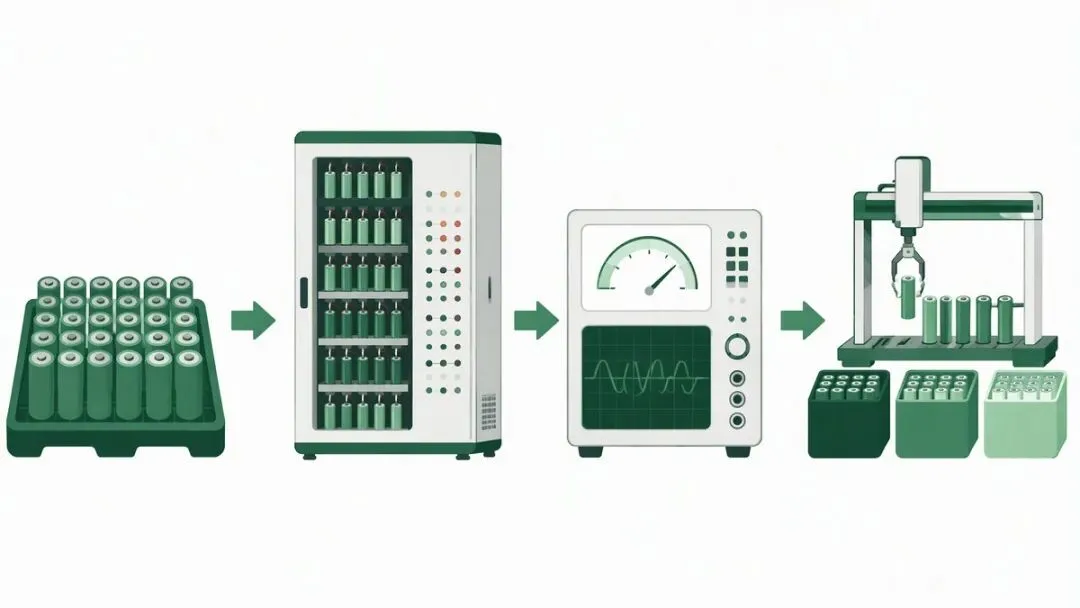
▲ 分容流程示意:上柜测试、静置测 K 值、自动分档、贴标入库
一条标准的分容线,电芯沿着四步走完"考试全程"(典型参数如下,以各厂工艺卡为准):
A standard grading line moves cells through four steps (typical parameters below, subject to each plant's process card):
| 分容四步走 · Four Steps |
| ① 装盘上柜 Loading:考生入场。 电芯按扫码顺序装入托盘,探针压紧正负极柱,一排几十上百颗同时"开考"。扫码绑定编号,后续每条数据都挂在电芯名下。 |
| ② 标准化充放电 CC-CV Cycling:同卷作答。 按统一程序做充放电循环,典型约 0.5C–1C、跑 1–2 圈,全程记录电压、电流、容量曲线;单颗典型分容时长约 2 小时以上(约 135 分钟量级,以各厂工艺卡为准)。 |
| ③ 静置测 K 值 Rest & K-value:交卷后的"复查"。 测试完成后静置(如 72 小时),观测开路电压降,计算自放电 K 值,把内阻测不出的微短路、毛刺隐患揪出来。 |
| ④ 自动分档贴标 Sorting & Labeling:发榜分班。 系统综合容量、内阻、OCV、K 值判定档位,机械手把电芯分入对应料盒,贴上等级标签,数据上传 MES,进入配组环节。 |
| 04 分容设备图鉴:谁在主持这场大考 Grading Equipment |
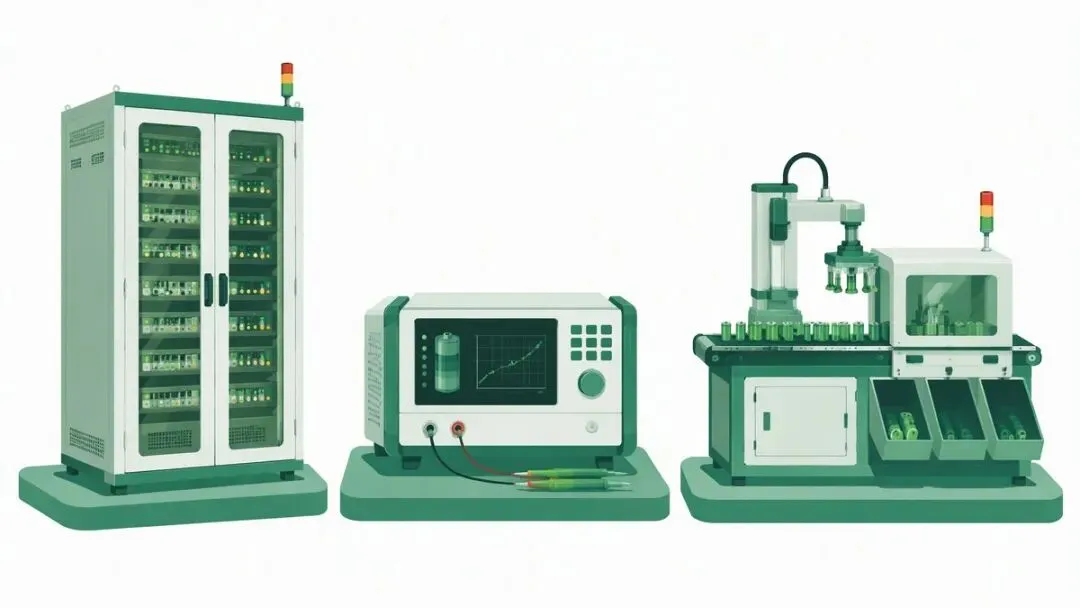
▲ 分容设备图鉴:分容柜、内阻测试仪与自动分档机协同工作
分容区的"监考官"们,各司其职:
The invigilators of the grading area each take their post:
| 设备图鉴速览 · Equipment at a Glance |
| 分容柜 Grading Cabinet:考场本体。 多通道恒流恒压充放电设备,每通道独立采样。典型电压量程 0–5V、精度 ±1mV,电流 30–150A、精度 ±0.1%FS(以各厂工艺卡为准),一台柜子几十到几百通道同时考核。 |
| 内阻测试机 IR Tester:体能测试仪。 测交流内阻 ACIR(1kHz 典型频率)或按需测直流内阻 DCIR,与分容柜数据联动,内阻超标的直接"不及格"。 |
| OCV 测试单元 OCV Measurement:状态核验。 静置后采集开路电压,检查极化和状态一致性;异常电压常与漏液、封装缺陷相关。 |
| 自动分档机 / 贴标机 Sorting & Labeling Machine:发榜机器。 机械臂按系统指令把电芯送入不同档位料盒,同时贴等级标签;全自动、可追溯,替代人工挑拣。 |
| 静置库 Resting Room:等待复查的"候考室"。 恒温环境(典型 20–30℃,均匀性 ±2℃,以各厂工艺卡为准),让电芯静置测 K 值,温度失控会直接扭曲自放电结论。 |
| 能量回馈单元 Energy Feedback System:节能"回收站"。 放电时把电能回馈电网或内部母线再利用——分容是电耗大户,能量回馈能回收大量放电能量,是产线降本的重要一环。 |
| 05 怎么分档?——A/B/C 的逻辑 How Grades Are Assigned |
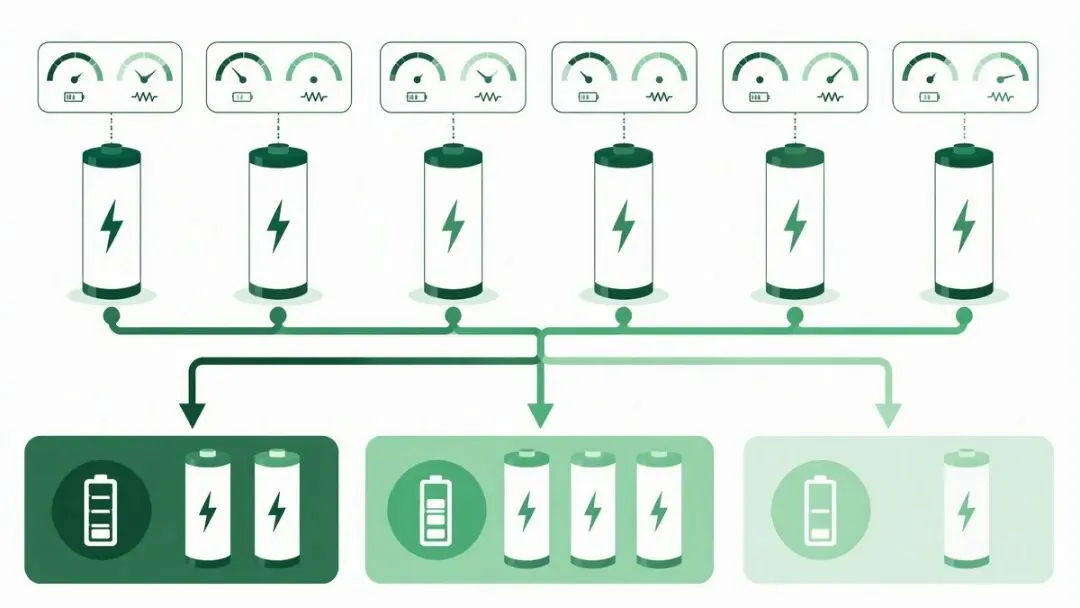
▲ 分容分档示意:按容量与内阻测试结果分成不同档位
分档先设"及格线":容量达标、内阻不超阈值、OCV 正常、K 值合格、外观无缺陷——全部通过才有"毕业证"。再按容量高低与参数接近程度细分 A/B/C 档:
Grading first sets a passing line: capacity on spec, resistance under threshold, normal OCV, qualified K-value and no visual defects — pass all of them to "graduate". Then cells are subdivided into A/B/C grades by capacity level and parameter closeness:
| 档位划分 · Grade Bins |
| A 档:尖子生。 容量高、内阻小、K 值稳,各项参数高度一致——用于动力电池、高端储能等追求性能与寿命的 Pack。 |
| B 档:优等生。 参数满足规格、略有差异,用于消费电子、常规储能等性价比场景。 |
| C 档 / 待淘汰:边缘考生。 临界合格或有单项偏弱,降级使用、返修或报废;K 值超标的直接隔离,绝不放行。 |
关键思想:分档不是为了"评优劣",而是为了"保一致"。同档电芯参数越接近,组 Pack 后的容量利用率越高、寿命越整齐、热管理越省心。所以分容的核心产出不是"分数线",而是"同班同学"的均匀度。
Key idea: grading is not about judging good or bad, but ensuring consistency. The closer the parameters within one grade, the higher the pack capacity utilisation, the more uniform the life, and the easier the thermal management. So the core output of grading is not a score line, but the uniformity of "classmates".
| 06 质量控制要点与常见异常对策 Quality Control & Troubleshooting |
分容是电芯"出厂前最后的检察官",五个质控点盯死:
Grading is the last inspector before cells leave the factory. Five QC points must be watched closely:
| 五大质控要点 · Five QC Points |
| 1. 容量一致性 Capacity Consistency。 同档容量偏差严格控制(典型 2% 以内,以各厂工艺卡为准),偏差红线直接决定分档可信度。 |
| 2. 内阻阈值 IR Threshold。 超阈值内阻必须剔除并追溯来源(焊接、极耳、界面),防止"高内阻电池"流进 Pack 埋下发热隐患。 |
| 3. K 值 / 自放电管控 K-value Control。 K 值超标(如 ≥2 mV/天,以各厂工艺卡为准)的电芯一律隔离复测,杜绝微短路电芯入组。 |
| 4. 温度一致性 Temperature Uniformity。 分容房与静置库严格恒温(典型 20–30℃、均匀性 ±2℃,以各厂工艺卡为准)——温度漂移 1℃,容量与内阻读数就会"骗人"。 |
| 5. 设备通道校准 Channel Calibration。 分容柜通道定期校准电压/电流精度,通道偏差会批量误判——校准记录是质量审核的硬证据。 |
常见异常与对策,一表理清(参数以各厂工艺卡为准):
Common defects and countermeasures (parameters per each plant's process card):
| 常见异常与对策 · Defects & Actions |
| 容量普遍偏低: 多为化成不充分、注液量不足或水分超标。对策:复核化成制度、注液量与极片烘烤状态,必要时抽样复测容量。 |
| 内阻偏大或离散: 常指向焊接不良、极耳虚焊或界面接触问题。对策:追溯装配焊接工序参数,对内阻异常电芯做解剖验证。 |
| K 值超标(自放电大): 微短路、毛刺刺穿隔膜或金属异物。对策:整批隔离排查卷绕/装配环节,异物管控升级,电芯报废不放行。 |
| OCV 离散大: 静置不足、温度不均或前序化成差异。对策:延长静置时间、校验温场均匀性、复测化成参数波动。 |
| 档位分布异常波动: 同批 A 档占比骤变,多为前工序(匀浆、涂布、化成)波动传导。对策:沿 MES 数据链反查各工序窗口期参数。 |
| 07 重点专业词汇双语速查表 Key Vocabulary (Bilingual) |
按主题分组,方便对照记忆——建议收藏慢慢看:
Grouped by theme for easy memorisation — save it for later:
| ① 工序与流程 · Process & Procedure |
| 1分容 / 容量筛分 Grading / Capacity Sorting 对化成后电芯做标准化充放电测试,按容量与内阻分档归类。 |
| 2充放电循环 Charge-Discharge Cycling 按标准程序对电芯充电再放电的完整过程,用于测容量。 |
| 3静置 Resting / Standing 测试后让电芯在静置库中放置,观察电压降以计算 K 值。 |
| 4分档 / 分选 Sorting / Binning 按测试结果把电芯送入不同档位料盒的过程。 |
| 5配组 Cell Matching 把同档、同批次、参数接近的电芯组合成电池组。 |
| 6化成 Formation 分容前工序,首次充放电激活材料并生成 SEI 膜。 |
| ② 电学参数 · Electrical Parameters |
| 1容量 Capacity 电芯在标准条件下放出的电量,单位 Ah / mAh,分容的核心指标。 |
| 2内阻 Internal Resistance (IR) 电流通过电芯内部的阻力,内阻大则发热多、出力差。 |
| 3交流内阻 ACIR (1kHz) 用交流小信号(典型 1kHz)测得的内阻,测速快、用于在线筛选。 |
| 4直流内阻 DCIR 大电流脉冲下测得的内阻,更贴近真实使用工况。 |
| 5开路电压 Open Circuit Voltage (OCV) 静置稳定后的端电压,用于判断电量与状态一致性。 |
| 6K 值(电压降) K-value (Voltage Drop) 静置期间电压下降速率(mV/天),衡量自放电大小。 |
| 7自放电 Self-Discharge 电芯储存中内部电量自行流失的现象,过大预示微短路等缺陷。 |
| ③ 设备与质控 · Equipment & QC |
| 1分容柜 Grading Cabinet 多通道充放电测试设备,同时考核成百上千颗电芯。 |
| 2通道 Channel 分容柜中独立控制与采样的测试单元,一通道对一颗电芯。 |
| 3恒流恒压 CC-CV 先恒流充到截止电压、再恒压维持到电流衰减的充电方式。 |
| 4档位 Grade Bin 按测试结果划分的等级料盒,如 A / B / C 档。 |
| 5一致性 Consistency 同档电芯参数之间的离散程度,越小越利于组包。 |
| 6能量回馈 Energy Feedback 将放电能量回馈电网/母线再利用,降低分容电耗。 |
| 7制造执行系统 MES Manufacturing Execution System,记录并追溯每颗电芯工艺与质量数据。 |
| 08 学习小贴士:三个一定记住 Study Tips |
| 三个一定记住 · Three Things to Remember |
| 1. 分容 = 电芯的"高考":同卷同标准,按成绩分班。 容量、内阻、OCV、K 值四张成绩单全过线,才有"毕业证";分档不是评优劣,是为了保一致性。 |
| 2. K 值是"测谎仪",专抓微短路。 静置 72 小时测电压降,K 值超标的一颗电芯足以拖垮整组 Pack——宁可多等三天,不放一颗"带病"电芯。 |
| 3. 一致性比绝对值更重要。 木桶效应下,整组性能由最差电芯决定;分容的产出不是"分数",而是"同班同学"的实力整齐。 |
1. Grading is a cell's "gaokao": same paper, same standard, sorted by score. 2. The K-value is a "lie detector" that catches micro-short-circuits. 3. Consistency matters more than absolute values — a pack is as strong as its weakest cell.
分容给每颗电芯定了"身价",下一步就要把它们装进同一个"班级"组成电池包——PACK 组装(Cell-to-Pack)。下期我们聊「PACK 组装:从电芯到电池包,一颗颗"尖子生"如何组队成团」,敬请期待!
Grading sets each cell's price tag. Next, these "classmates" are assembled into battery packs — cell-to-pack. Next episode: Pack Assembly — from cells to a battery pack. Stay tuned!
本系列为「锂离子电池制备(双语教材)」公众号内容,聚焦电池制造各工序的中英文知识。欢迎关注,考试和生产都用得上。
本文为工艺科普性质,文中参数为常见工艺窗口示例,具体以各厂工艺文件为准。This article is for educational purposes; parameters are typical process-window examples and subject to each plant's process documents.

