锂离子电池制备(双语教材)|入壳与注液:让电芯安家,再喝饱电解液
- 2026-11-19 05:40:18
上一期我们讲完了电芯装配的「合体时刻」:卷绕与叠片,把正负极片和隔膜组装成裸电芯(Bare Cell)。可裸电芯还「住」不了电池盒——它没有坚硬外壳保护,内部也还没有离子的「血液」。今天这一期,我们给电芯办两件大事:入壳(Canning),给它安一个安全的「家」;注液(Electrolyte Filling),让它喝饱电解液,从此有了搬运锂离子的能力。
Last issue we witnessed the "assembly moment" of cell manufacturing: winding and stacking, combining cathodes, anodes and separators into a bare cell. But a bare cell cannot live in a battery pack yet — it has no hard case for protection, and no ion-carrying "blood" inside. In this issue we do two big things for the cell: canning, giving it a safe "home", and electrolyte filling, letting it drink up so it can transport lithium ions.
| 01 什么是入壳与注液?——电芯的「安家」与「饱腹」时刻 What are Canning and Filling? |
一句话理解:入壳是把组装好的裸电芯装进金属壳或铝塑膜里,再完成封口密封;注液是在密封前,把定量的电解液(Electrolyte)注入电芯内部,让液体浸透每一层极片的孔隙。
In one sentence: canning puts the assembled bare cell into a metal case or aluminum laminate pouch and seals it; filling injects a precise amount of electrolyte into the cell before final sealing, letting the liquid soak through the pores of every electrode layer.
为什么这两道工序如此关键?因为外壳决定电池能不能扛住机械冲击、能不能隔绝水汽氧气;而电解液是锂离子在正负极之间穿梭的唯一通道——液少了,容量上不去;液多了,游离电解液会在循环中消耗活性锂。可以说,入壳决定电池「住得安不安全」,注液决定电池「跑得远不远」。
Why are these two steps so critical? The case decides whether the battery can withstand mechanical shock and keep out moisture and oxygen; the electrolyte is the only pathway for lithium ions to travel between the electrodes — too little means low capacity, too much means free electrolyte consuming active lithium during cycling. Canning decides whether the battery "lives safely", filling decides how far it can "run".
| 02 入壳工艺:三种外壳,三条「安家」路线 Canning: Three Cases, Three Routes |
入壳前,上一期的芯包还要经过热压整形:把卷芯或叠片芯压到规定尺寸,消除层间间隙,让芯包与外壳的配合严丝合缝,防止入壳时擦伤极片。壳体进线前也要经过清洗、干燥、除尘,重点控制残留水分——壳体越干净,后道注液越安心。
Before canning, the core from the previous step is hot-pressed and formed to its specified dimensions, eliminating gaps between layers so the core fits the case perfectly without scratching electrodes during insertion. Cases are also cleaned, dried and de-dusted before entering the line, with special attention to residual moisture — the cleaner the case, the safer the later filling.
入壳之后是封口(Sealing)。按外壳材料分,业界主流是三条路线,各有一套「安家」方式:
After canning comes sealing. By case material, the industry mainly follows three routes, each with its own way of "settling in":
| 三条路线 · Three Routes |
| 圆柱 Cell Cylindrical |
| 方形 Cell Prismatic |
| 软包 Cell Pouch |
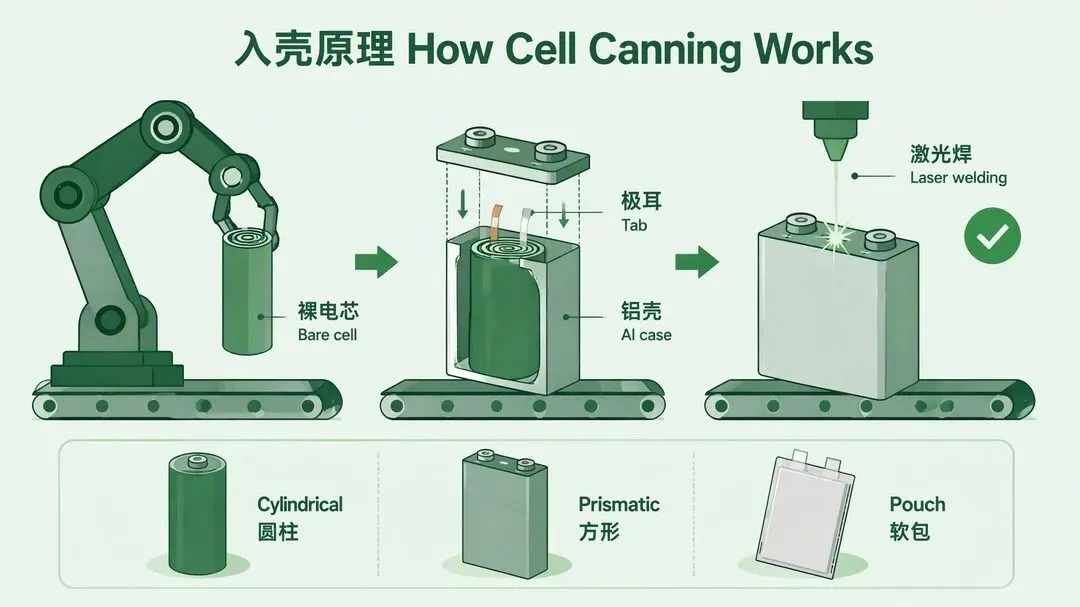
▲ 入壳原理图:裸电芯入铝壳,极耳对接,激光焊封顶盖(Schematic of cell canning)
三种外壳有个共同的底线:气密性(Hermeticity)。封口之后电芯要经氦质谱检漏——用氦气作示踪气体,测壳体有没有看不见的微漏。方壳高压工艺对气密性的要求通常在 ≤1×10⁻⁷ Pa·m³/s 量级(具体以各厂工艺卡为准),越严,电池在高温、高海拔等环境下越安全。
All three cases share one bottom line: hermeticity. After sealing, cells undergo helium mass-spectrometry leak testing — helium acts as a tracer gas to detect invisible micro-leaks. For prismatic high-pressure processes, the leak rate is usually required to be on the order of ≤1×10⁻⁷ Pa·m³/s (subject to each plant’s process card); the tighter, the safer the cell under high temperature and high altitude.
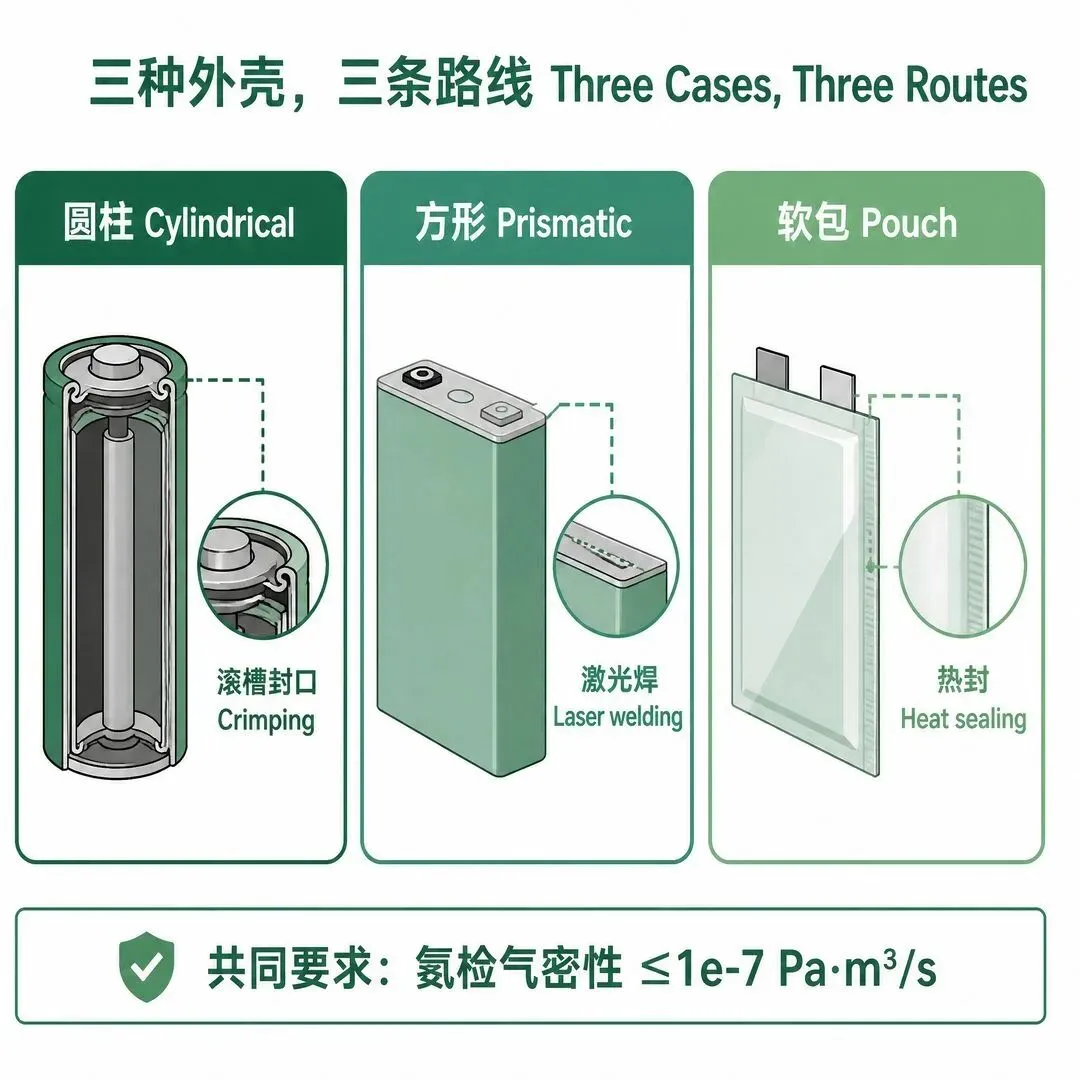
▲ 三种外壳,三条路线:圆柱滚槽封口、方形激光焊、软包热封(Three cases, three routes)
| 03 注液工艺:让电解液浸润每一寸极片 Filling: Soak Every Inch of the Electrodes |
注液是电解液从「油箱」进入「发动机」的过程。电解液由锂盐、有机溶剂和添加剂配成,怕水、怕氧、怕高温——所以注液必须在干燥房(Dry Room)里完成:装配、焊接区域露点通常要求 ≤-40℃,注液区域更严,常要求露点 ≤-50℃(以各厂工艺卡为准)。
Filling is the journey of electrolyte from the "fuel tank" into the "engine". Electrolyte is formulated from lithium salt, organic solvents and additives; it fears water, oxygen and heat — so filling must be done in a dry room: the assembly/welding area usually requires a dew point ≤ -40 °C, and the filling area is even stricter, often ≤ -50 °C (subject to each plant’s process card).
电芯内的极片孔隙又细又密,常压下液体很难快速渗入,还容易残留气泡。为此业界普遍采用真空注液(Vacuum Filling):先把注液腔抽真空(常见约 -0.09 MPa),让孔隙里的空气被抽走,再借负压把电解液「吸」进电芯;破真空瞬间,外界压力还会把液体进一步「压」进深处。
Electrode pores are fine and dense; under ambient pressure liquid penetrates slowly and air bubbles tend to remain. That is why vacuum filling is widely used: the filling chamber is first evacuated (commonly around -0.09 MPa) to pull air out of the pores, then negative pressure "sucks" the electrolyte into the cell; when vacuum is released, external pressure pushes the liquid even deeper.
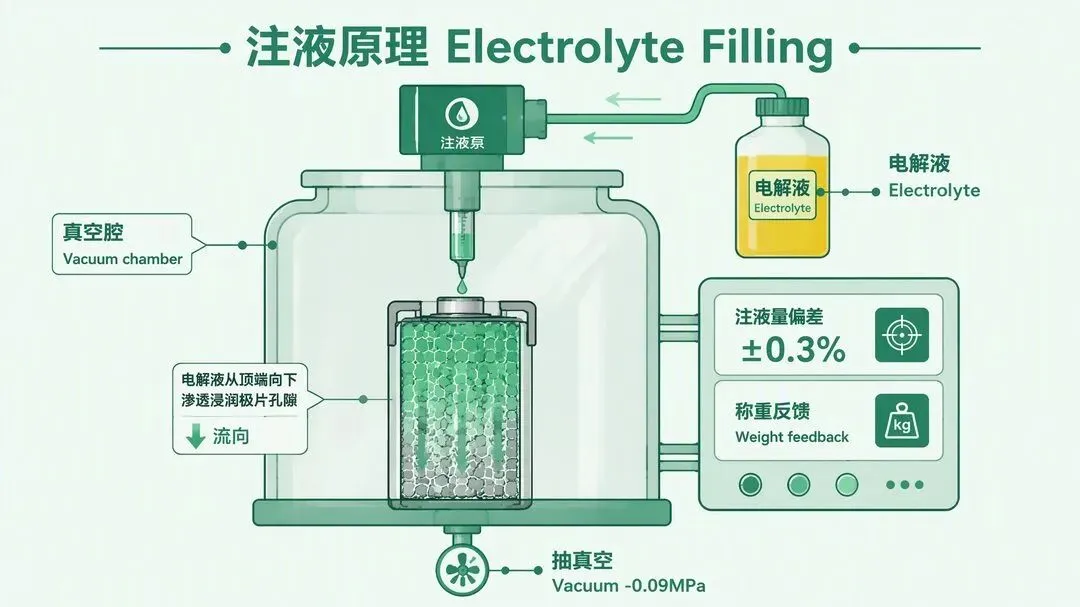
▲ 注液原理图:真空腔负压吸液,电解液自上而下浸润极片孔隙,称重反馈闭环控制注液量(Schematic of vacuum electrolyte filling)
注液量由称重反馈(Weight Feedback)闭环控制:注液前后各称一次,差值就是注入量,偏差超限立即报警修正。高精度产线的单次注液量偏差可控制在 ±0.3% 以内,称重精度可达 ±5 mg 级(以各厂工艺卡为准)。注液速度一般控制在 0.5~2 g/s,太快容易溅液、带气泡,太慢拖低节拍。
The fill volume is closed-loop controlled by weight feedback: the cell is weighed before and after filling, and the difference is the injected amount; any deviation beyond limits triggers an alarm and correction. High-precision lines can hold single-shot filling deviation within ±0.3%, with weighing accuracy at the ±5 mg level (subject to each plant’s process card). Filling speed is usually 0.5–2 g/s — too fast causes splashing and bubbles, too slow drags down the takt time.
电流密度的均匀性还依赖一道道「耐心」:浸润静置(Wetting & Rest)。注液完成不等于浸润完成——电解液需要时间渗进极片最深处。常见做法是阶梯式真空静置(如二次抽真空至约 -0.08 MPa、保持约 10 s 再破真空),配合 45~60℃ 的高温静置房加速浸润;不同体系时间不同,三元体系常温静置常见 30~45 min,磷酸铁锂常为 20~30 min(孔隙率高的体系可更短,以各厂工艺卡为准)。
Uniform current density also depends on patience: wetting and rest. Filling done does not mean wetting done — electrolyte needs time to penetrate the deepest parts of the electrodes. A common practice is stepped vacuum rest (e.g., second evacuation to about -0.08 MPa held for about 10 s before venting), combined with a 45–60 °C hot rest room to accelerate wetting. Holding times differ by chemistry: ternary systems commonly rest 30–45 min at room temperature, LFP commonly 20–30 min (shorter for high-porosity systems; subject to each plant’s process card).
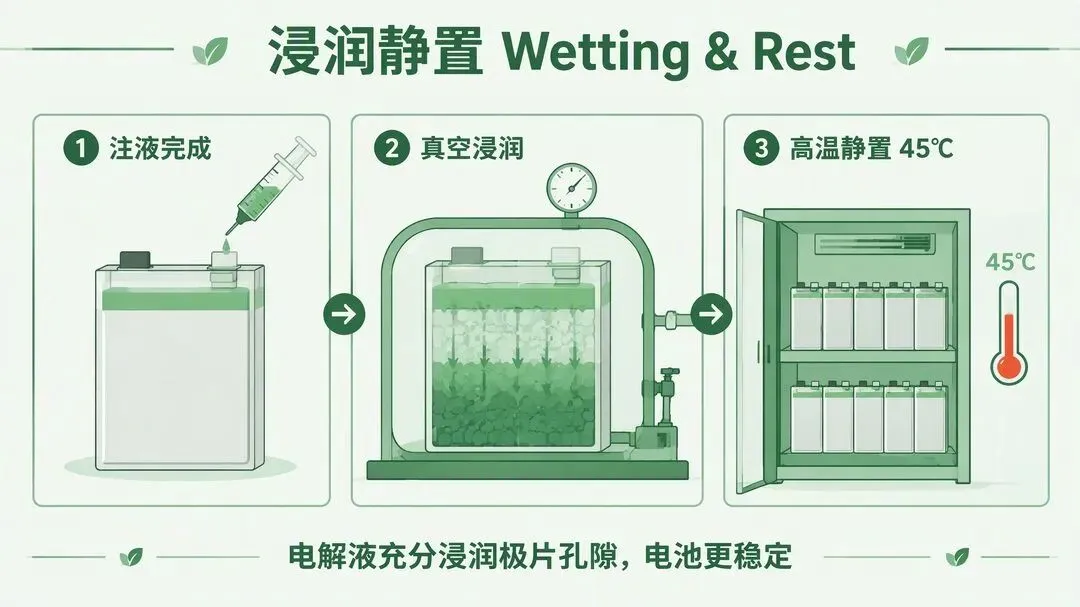
▲ 浸润静置流程:注液完成 → 真空浸润 → 高温静置,让电解液充分渗入极片孔隙(Wetting and rest process)
| 04 设备图鉴:入壳与注液车间的主力军 Equipment at a Glance |
这道工序的设备既精密又「娇气」,主角是下面这几台:
The equipment here is both precise and delicate. The main players are:
| 设备速览 · Equipment Overview |
| 入壳机 Canning machine |
| 激光焊接机 Laser welder |
| 滚槽封口机 Crimping machine |
| 热封机 Heat sealing machine |
| 真空注液机 Vacuum filling machine |
| 氦质谱检漏仪 Helium leak detector |
| 干燥房与露点监控 Dry room & dew-point control |
| 浸润静置设备 Wetting & rest systems |
| 05 质量控制要点:水分、液量与密封,一个都不能少 Quality Control: Moisture, Volume and Sealing |
入壳与注液是电池「漏气、产气、鼓包」的高发工序,质量管控要盯紧三个维度:环境水分、注液精度、密封强度。关键参数如下:
Canning and filling are where leaking, gassing and swelling most often originate. Quality control centers on three dimensions: environmental moisture, filling accuracy and sealing strength. Key parameters:
| 关键工艺参数 · Key Process Parameters |
| 干燥房露点 Dew point |
| 注液量偏差 Filling deviation |
| 注液速度与真空度 Filling rate & vacuum |
| 气密性 Hermeticity |
| 浸润时间 Wetting time |
把常见问题的现象、原因和处置放在一张表里,现场对照着查:
Common issues, causes and countermeasures at a glance:
| 常见问题与对策 · Troubleshooting |
| 注液量不足 Underfill |
| 注液过量 Overfill |
| 气密性不合格 Leak |
| 气泡残留 Bubbles |
| 水分超标 Moisture |
参数说明:以上数值为常见工艺窗口示例,具体以各厂工艺卡为准——不同材料体系、不同壳体构型,注液量与露点要求都可能不同。
| 06 重点专业词汇双语速查表 Key Vocabulary (Bilingual) |
按主题分组,方便对照记忆——建议收藏慢慢看:
Grouped by topic for easy memorization — save this for later:
| ① 工序与工艺 · Process & Methods |
| 1入壳 Canning / Case Insertion 把裸电芯装入金属壳或铝塑膜并完成密封的工序。 |
| 2注液 Electrolyte Filling 向电芯内注入定量电解液的工序。 |
| 3真空注液 Vacuum Filling 先抽真空再借负压吸入电解液的注液方式,利于排泡与浸润。 |
| 4浸润静置 Wetting & Rest 注液后让电解液充分渗入极片孔隙的静置过程。 |
| 5滚槽封口 Crimping 圆柱电池通过机械滚压使壳体与盖板咬合密封的方式。 |
| 6激光焊 Laser Welding 用高能激光束熔化金属接缝实现致密密封的焊接方式。 |
| 7热封 Heat Sealing 通过加热加压使铝塑膜内层热熔粘合完成密封的方式。 |
| ② 结构与部件 · Structure & Components |
| 1裸电芯 Bare Cell 已卷绕或叠片、尚未入壳注液的电极-隔膜组合体。 |
| 2外壳/壳体 Case / Can 容纳电芯的金属或铝塑膜容器,兼具保护与隔绝功能。 |
| 3顶盖 Top Cover 方形电池封口盖板,集成极柱与防爆阀,与壳体激光焊密封。 |
| 4极耳 Tab 从电极引出的金属导电带,负责电流引出与极柱连接。 |
| 5注液口 Filling Port 壳体或铝塑膜上预留的注液孔,注液后封堵或热封。 |
| 6铝塑膜 Aluminum Laminate / Pouch Film 软包电池的外壳材料,PA-Al-PP 三层复合,兼具强度与密封。 |
| 7电解液 Electrolyte 由锂盐、有机溶剂与添加剂组成,承担锂离子传输。 |
| ③ 设备与检测 · Equipment & Inspection |
| 1入壳机 Canning Machine 自动将整形后的芯包精确放入壳体的设备。 |
| 2激光焊接机 Laser Welding Machine 完成方壳顶盖与壳体密封焊接的设备。 |
| 3真空注液机 Vacuum Filling Machine 集抽真空、定量注液与称重反馈于一体的注液设备。 |
| 4注液泵 Filling Pump 精密计量输送电解液的泵组,带流量/压力反馈。 |
| 5称重系统 Weighing System 通过注液前后称重差值闭环控制注液量的装置。 |
| 6静置房 Resting Room / Chamber 恒温真空静置设备,用于加速电解液浸润。 |
| 7氦质谱检漏仪 Helium Leak Detector 以氦气为示踪气体检测壳体微漏的高灵敏度仪器。 |
| 8干燥房 Dry Room 低露点、低湿度的作业环境,保障注液工序水分受控。 |
| 07 学习小贴士:三个「一定」记住 Study Tips: Three Things to Remember |
第一,入壳三条路,密封是底线:圆柱滚槽、方壳激光焊、软包热封,路线不同,但氦检气密性这一关谁都逃不掉——密封不好,漏液、鼓包、着火都会找上门。
First, three canning routes share one bottom line — sealing. Cylindrical crimping, prismatic laser welding and pouch heat sealing differ, but all cells must pass helium leak testing; poor sealing invites leakage, swelling and even fire.
第二,注液三件宝:真空、称重、浸润:真空排泡让液体进得去,称重反馈让液量刚刚好,浸润静置让液体渗得透——三者缺一,容量和内阻就会「说话」。
Second, filling relies on three treasures: vacuum to drive liquid in, weight feedback to get the volume just right, and wetting rest to let it soak through — miss any one, and capacity and resistance will tell.
第三,水是本工序最大的「敌人」:露点 -40℃、-50℃ 不是刻意为难产线——每多一克水分,电解液分解与 SEI 膜受损的风险就高一分。控制住水,就控制住了电池的寿命与安全。
Third, moisture is the biggest enemy of this process. Dew points of -40 °C and -50 °C are not there to make life hard for the line — every extra gram of water raises the risk of electrolyte decomposition and SEI damage. Control moisture, and you control battery life and safety.
下期预告 · Next Episode:注液之后,电芯肚子里有电解液了,但还不能直接出厂——还需要一次决定「生死」的首次充电:化成(Formation),以及最后的封口与分容(Sealing & Grading)。下一期我们讲制成工序的收官之战:化成与封装,欢迎关注,考试和生产都用得上。
本文为工艺科普性质,文中参数为常见工艺窗口示例,具体以各厂工艺文件为准。

